Title: Action Item: Assigning STEM AC Math Digital Learning Student Licenses
Date: 08/28/2026
To: All School Administrators
From: Holley McIntosh, STEM Director
Dr. Tiffany Hall, Executive Director of Teaching & Learning
Subject: Assigning STEM Action Center (STEM AC) Math Digital Learning Student Licenses
Summary:
The math digital learning student licenses awarded to schools from the STEM AC Math Digital Learning Grant will be assigned by SLCSD IT Department.
Administrators must submit a SLCSD IT helpdesk ticket to inform IT how the licenses are to be assigned in their school.
Rationale:
The STEM AC did not have sufficient resources to fund any school’s full grant request for licenses. As only a portion of the licenses you requested were provided, schools need to be strategic in assigning licenses to classes or students that will best use them. The STEM AC tracks student usage to ensure license are being used at appropriate levels.
Schools not using their licenses by October 30, 2026 run the risk of having the STEM AC reassign their licenses to another school in the state.
Expectations for Implementation:
Communication
Administrators are responsible to tell teachers in their building which grade levels and specific teachers have access to these programs.
Administrators are responsible to submit a helpdesk ticket to the SLCSD IT Department. Note in the ticket*:
the name of the math digital learning supplemental program you received from the STEM AC grant
which grade levels or specific teachers are to have licenses
how many licenses for the grade levels or specific teachers
One exception: High school ALEKs licenses will be managed and assigned by your HS Math Coach/Content Area Specialist.
Collaboration:
Contact Holley McIntosh if you have questions about your school’s STEM AC grant award.
Work with the District Math Coach/CAS assigned to your school if you have questions about how to match these licenses with student needs.
Evaluation
Administrators communicate the appropriate assignment of the awarded licenses to IT.
Administrators ensure the licenses are used appropriately and as a supplement to our adopted core programs.
See the conditions of the STEM AC grant for more information.
Keywords: STEM Action Center, STEM AC, math, digital learning licenses, math student licenses
*Helpdesk Directions: First Button > Category: Applications > Subcategory: Your selected program > Subject: Assign Licenses
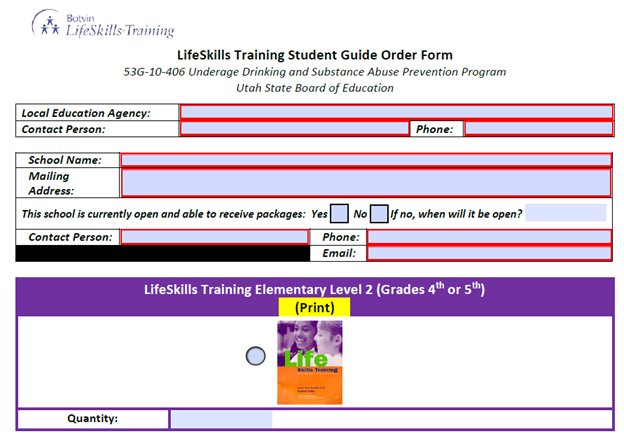
It is now time to fill out the BOTVIN forms for your schools. Below is a picture of that application, and what should be put into the appropriate boxes. If you are new to this process, Botvin LifeSkills Training is the only approved program that meets the requirements outlined in UCA § 53G-10-406 and R277-910. The program must be offered to all students in grades 4 or 5, 7 or 8, and 9 or 10 (UCA § 53G-10-406). In Salt Lake City School District, we begin our program in 5th grade.
All 5th grade teachers must receive the BOTVIN training. If a teacher is new to the district, or has been teaching in another grade, please make sure they get notified to take the training through Clarissa Stebbing. Required Teacher Training -New Simplified Registration Process
For schools filling out the form, below is a sample of what you should put in the boxes. If you have questions, please reach out to Katie Lowery or Clarissa Stebbing.
Please have your school secretaries send the form to AMY BURRIS and we will send in the numbers for our district. Ordering Student Guidebooks
See the highlighted links below for TEACHER MANUALS AND RESOURCES
From: Dr. Tiffany Hall, Executive Director Teaching & Learning
Subject: ESL Endorsements
Summary:
In the Salt Lake City School District, every educator plays an important role in supporting English learners. As an administrator, you can choose to complete the full ESL endorsement, or just complete three classes for the modified endorsement.
Endorsement Options
A state ESL endorsement, recognized by the Utah State Board of Education (USBE); or
A district-modified ESL endorsement, recognized within SLCSD:
Understanding Language Acquisition and Cognition
Foundations of Cultural Diversity
Family and Community Engagement in ESL Education
The state ESL endorsement may be earned by:
Completing five graduate-level courses with a grade of C or better; or
Passing the Teaching English to Speakers of Other Languages Praxis Exam (5362); and
Submitting your application to the USBE to place the endorsement on your license.
Rationale:
This is a district requirement outlined in your employment contract.
Expectations for Implementation:
Communication
The next cohort will begin in April 2027, and registration information will be emailed to all educators in February 2027.
For additional information, including district-modified endorsement requirements, please visit the SLCSD ESL Endorsement webpage.
Announcements SLCSD Priorities 2026-27 - Our top priorities highlighted from our strategic plan for student success. (Draft only!!) Common Expectations – Administrative guiding document for 26-27 school year. Leadership Academy – Moving from the classroom or coaching role into school administration is a major shift. The Assistant Principal Leadership Academy is built to help our 1st and 2nd year assistant principals successfully navigate that transition and grow their leadership capacity. This program gives you direct, hands-on experience with the actual district systems and operational practices that keep a building running smoothly. Over the course of the year, we will dig deep into student services, special education compliance, master scheduling, and CELEBRATIONS – Please send to leeson.taylor@slcschools.org or angelina.tovar@slcschools.org by Wednesday at 5:00 PM. Attendance and Engagement Meta Network celebration Salt Lake City School District has been accepted into the National Attendance and Engagement Meta Network, a Gates Foundation-funded initiative focused on improving student attendance and engagement. East, West, and Horizonte will represent the district in this national learning network, collaborating with schools and districts across the country to identify, implement, and refine strategies that reduce chronic absenteeism and strengthen student connection to school. We appreciate the leadership of the East, West, and Horizonte teams for taking on this work and look forward to sharing lessons learned across the district throughout the year. ALL ADMINISTRATORS – Items for all building level administrators DEADLINES PUBLISHED 2026 Principal Tackle List.docx ACTION ITEMS 26-27 Title IX Trainings – Required trainings for Title IX and updating your school's Deputy Title IX Coordinator information. 26-27 Start of School Title I Updates – To support a successful beginning to the 2026–2027 school year, we are asking the principals of Title I schools to please complete the following required Title I tasks by Friday, August 28, 2026. Completing these items early will help ensure your school is well prepared for the year ahead. If you need assistance at any point, please do not hesitate to reach out to Dr. Taylor. INFORMATION ITEMS Attendance Update August 2026.docx -this is the first attendance newsletter for the 26-27 school year. Attendance-Based Grading Under HB 502 Guidance – The Salt Lake City School District is providing the following guidance regarding attendance-based grading under HB 502. This guidance is intended to support a fair, transparent, and consistent approach across our secondary schools while ensuring that students and families clearly understand how attendance may affect a course grade. Enrollment Guidance Related to SB 167 – We recognize that schools have received a number of questions regarding student enrollment requirements and the implementation of SB 167. We appreciate your continued attention to this matter and your efforts to ensure that enrollment decisions are handled consistently and appropriately across the district. Edia Implementation and Attendance Communication – See important information regarding our implementation of Edia attendance software. Assessment Plan for SY 2026-27 – This document is the comprehensive overview of assessments. For specific dates of testing windows, questions about administration, or training on administration, please contact Dr. Patrick Jefferies, Assessment & Evaluation Supervisor. Transportation Contact Information -- As we prepare for the upcoming school year, we would like to share the Salt Lake City School District Transportation Department contact information to help ensure you can quickly connect with the appropriate staff for transportation-related needs. Standard Operating Procedures for Zūm Pass Usage, Student Boarding, and Space-Available (Transportation) – The Salt Lake City School District is implementing consistent procedures for Zūm pass usage, student boarding, transportation eligibility, and space-available transportation requests for the 2026–27 school year. USBE Updates School LAND Trust – USBE is excited to announce a new Canvas course designed to support District Principals in administering the School LAND Trust (SLT) program. District principals are vital to ensuring School Community Councils (SCC) are properly formed and funds are used to address critical academic needs. SEOP Newsletter – August newsletter USBE August Attendance Newsletter – USBE Attendance information for the month of August.
HIGH SCHOOLS – Items for high school administration DEADLINES ACTION ITEMS Calculating Added Value GPA -- Additional value is awarded to courses that demonstrate a higher level of academic rigor. This system ensures students are recognized for the commitment they make when enrolling in advanced coursework. INFORMATION ITEMS Monthly Registrar Meetings -- Mandatory monthly meetings for high school registrars are essential to ensure consistency, efficiency, and compliance across the school district. These meetings serve several critical functions: MIDDLE SCHOOLS –Items for middle school administration DEADLINES ACTION ITEMS INFORMATION ITEMS ELEMENTARY SCHOOLS – Items for elementary school administration DEADLINES ACTION ITEMS INFORMATION ITEMS Math Acadience Order process for 2026-27: Any school can use manual licenses for K-3 Math Acadience paid for by USBE. Schools can pay $2.95/student with school funds to upgrade to digital licenses and avoid hand entry of data in K-1. For more details, please click here. To order licenses for grades 4-6, email quotes@acadiencelearning.org to purchase. TRAINING: Starting now, participants can self-enroll in the Canvas course for the SY26-27 administration and scoring of the Acadience Math assessments. Once they complete the module(s) and submit the survey they will receive a certificate of completion. Self-enroll URL link https://usbe.instructure.com/enroll/C6FRBW Please reach out to Dr. Patrick Jefferies, Assessment & Evaluation, with questions. patrick.jefferies@slcschools.org RESOURCES AVAILABLE FOR SCHOOLS FROM DISTRICT DEPARTMENTS SPED Scoop – Special Education Newsletter Student Services Resources Teaching & Learning Salt Lake City Education Foundation School Leadership & Support Administrative Memos
*Unless otherwise requested, information will run for 2 weeks only.
To: Principals, School Administrators, Teachers, and Transportation From: Ken Martinez, Transportation Director, Isaac Astill, Executive Director, Auxiliary Service
Date: August 13, 2026 Subject: Standard Operating Procedures for Zūm Pass Usage, Student Boarding, and Space-Available (Transportation)
Purpose
The Salt Lake City School District is implementing consistent procedures for Zūm pass usage, student boarding, transportation eligibility, and space-available transportation requests for the 2026–27 school year.
The purpose of these procedures is to strengthen student safety, improve communication with families, provide accurate ridership information, and support effective transportation planning. At the same time, our primary responsibility is to ensure that students are transported safely to and from school.
The 2026–27 school year will begin with a soft implementation of Zūm pass usage. Students are expected and strongly encouraged to use their Zūm passes; however, students will not be denied transportation or left at a bus stop solely because they do not have, cannot locate, or are unable to use their Zūm pass.
These procedures apply to District-operated transportation routes and are intended to provide a clear and consistent approach for school administrators, staff, drivers, students, and families.
I. Zūm Pass Usage and Student Boarding
A. Encouraging Zūm Pass Use
Students who have been issued a Zūm pass should be encouraged to tap their pass when boarding and exiting the bus on every trip.
Consistent pass usage provides valuable information that supports:
Parent and guardian notifications;
Accurate student ridership information;
Transportation route planning;
Capacity planning; and
Accurate transportation records.
Schools should reinforce the importance of Zūm pass usage with students and families while emphasizing that the pass is intended to support transportation operations and student safety—not to create a barrier to transportation.
B. Students Without a Pass or With a Nonfunctioning Pass
If a student does not have a Zūm pass or is unable to use the pass:
The driver should politely remind the student to bring and use the pass on future trips.
The student should be allowed to board.
The driver should not delay the route or create a confrontation regarding a missing, lost, or nonfunctioning pass.
Repeated concerns should be reported to the Transportation supervisor.
Lost, damaged, or nonfunctioning passes should be addressed through the established replacement process. Students should continue to receive transportation while a replacement is being obtained.
II. Unknown or Potentially Ineligible Riders
There may be circumstances in which a student does not appear on the driver's current rider list, a Zūm pass does not register, or there is a question about whether the student qualifies for transportation.
In these circumstances:
The student should be allowed to board for that trip.
Drivers should not attempt to resolve transportation eligibility questions with students at the bus stop.
When necessary, the driver should record sufficient information to identify the student, including the student's name, school, route, and boarding location.
Eligibility concerns or repeated occurrences should be reported to the Transportation supervisor.
Transportation administration will review the student's eligibility and determine whether additional follow-up is necessary.
If a student appears to be repeatedly using transportation services for which they are not eligible, Transportation will work with school administration so that the concern can be addressed with the student and parent/guardian outside of the bus environment.
III. No Turn-Away Expectations
Drivers should make every reasonable effort to ensure that students are safely transported to and from school.
A student should not be denied boarding solely because:
The student forgot or lost their Zūm pass;
The student's pass does not scan;
The student does not currently appear on the driver's rider list; or
There is an unresolved question regarding transportation eligibility.
Eligibility questions, repeated misuse, and pass-compliance concerns should be addressed through the Transportation administrative process rather than by the driver at the bus stop.
If there is a safety concern or circumstance that prevents the bus from being operated safely, the driver should immediately communicate with Dispatch or a Transportation supervisor.
IV. Communication with Students and Families
Interactions with students should remain calm, respectful, and focused on safety.
Drivers and school staff should communicate that consistent Zūm pass use:
Provides important information and notifications to parents and guardians;
Helps the District understand actual ridership;
Assists Transportation with route planning and determining available capacity; and
Improves the accuracy of student transportation information.
The goal is to remove barriers to transportation while encouraging compliance.
School administrators should reinforce this message with students, families, and staff.
V. Transportation Eligibility and Space-Available Requests
The District recognizes that some students may request transportation even though they do not otherwise qualify under applicable transportation eligibility or distance requirements.
The District's space-available process is intended to provide a consistent method for considering these requests while ensuring that qualified students remain the priority and that actual route capacity is understood before space-available transportation is approved.
A. Qualified and Nonqualified Students
Qualified students are students who meet applicable state and District transportation eligibility requirements, including applicable distance requirements or District-approved safety-related exceptions.
Nonqualified students are students who do not meet the normal eligibility requirements but may request transportation when space is available on an existing route.
Qualified students will always receive priority when determining route assignments and available capacity.
VI. Beginning-of-Year Ridership Evaluation Period
For approximately the first four weeks of the 2026–27 school year, Transportation will evaluate actual student ridership on each route.
During this evaluation period:
Students will be strongly encouraged to consistently use their Zūm passes.
Transportation will use available ridership information, driver observations, and route data to establish actual route utilization.
Space-available and exception requests will generally not be approved until the evaluation period is completed.
Transportation will use this information to determine which routes have available capacity after qualified students have been accommodated.
This approximately four-week evaluation period replaces the previous practice of making determinations after approximately 15 school days.
VII. Students Riding During the Interim Period
During the beginning-of-year evaluation period, drivers should not independently remove, deny, or refuse transportation to a student because there is a question regarding eligibility.
If a potentially nonqualified student is already using a route:
The driver should continue transporting the student unless directed otherwise by Transportation administration.
Repeated or questionable use should be reported to the driver's supervisor.
Transportation will review the circumstances and coordinate with school administration when follow-up with the student or parent/guardian is necessary.
The intent is to resolve eligibility concerns administratively rather than leaving a student at a bus stop.
VIII. Space-Available Request Process
Following the approximately four-week ridership evaluation period, a parent or guardian may submit a Transportation Exception or Space-Available Request to the Transportation Department.
Transportation will consider:
Actual ridership on the requested route;
Bus seating and safe operating capacity;
Qualified students assigned to the route;
Historical and current ridership trends;
Route and stop locations;
Operational feasibility; and
Whether accommodation would require an additional route, vehicle, stop, or significant cost.
Space-available transportation may be approved when sufficient capacity exists after qualified riders have been accommodated.
IX. Approval and Denial of Space-Available Transportation
A. Approval
Space-available transportation may be approved when sufficient capacity exists and the request can be accommodated without negatively affecting qualified students or District operations.
Families should understand that:
Approval is based on available capacity.
Approval does not establish permanent transportation eligibility. It will be considered on a yearly basis.
The accommodation may be modified or discontinued if qualified ridership increases or operational needs change.
B. Denial
A request may be denied when:
Available capacity is insufficient;
The accommodation would negatively affect qualified riders;
An additional route, vehicle, stop, or significant operational expense would be required; or
Other operational or safety considerations prevent the accommodation.
Parents and guardians will be informed of the determination.
X. Ongoing Ridership and Eligibility Concerns
When Transportation identifies a student who appears to be repeatedly using services for which they are not authorized, the following process should be followed:
Driver: Report the concern to the Transportation supervisor.
Transportation: Verify the student's eligibility and circumstances.
Transportation: When appropriate, contact school administration.
School administration: Work with the student and parent/guardian to resolve the concern outside of the bus environment.
Drivers should not be placed in the position of confronting students about ongoing eligibility or removing students from transportation services without administrative direction.
XI. School Administrator Responsibilities
Principals and school administrators are asked to support consistent implementation by:
Communicating the expectations for Zūm pass usage to students and families;
Reinforcing that students should not be stranded because of a missing, lost, or nonfunctioning pass;
Directing transportation eligibility questions to Transportation rather than attempting to resolve them at the bus stop;
Supporting Transportation when repeated eligibility or ridership concerns require school-based follow-up;
Communicating with families in a calm, respectful, and solution-oriented manner; and
Helping students understand that Zūm pass usage supports safe and effective transportation planning.
School administrators should work collaboratively with Transportation when concerns arise and avoid placing drivers in the position of making eligibility determinations.
XII. Records and Communication
Transportation will maintain appropriate records related to:
Exception and space-available requests;
Approvals and denials;
Route capacity considerations; and
Significant or repeated eligibility concerns.
Schools and drivers will receive updated information as necessary when ridership assignments or transportation circumstances change.
XIII. Key Operating Principles
The following principles should guide implementation throughout the school year:
Student safety comes first.
Students should not be stranded while an eligibility question is being resolved.
Zūm pass usage should be strongly encouraged.
Qualified students receive priority for transportation.
Actual ridership should be established before space-available requests are approved.
Space-available transportation is not automatic and should be reviewed each school year.
Route capacity may change throughout the school year.
Drivers should transport, encourage, report, and communicate—not resolve eligibility disputes at the bus stop.
Closing
Thank you to our principals, school staff, Transportation team, and bus drivers for your partnership in implementing these procedures. A consistent, respectful, and student-centered approach will help us improve transportation operations while maintaining our shared commitment to student safety.
When questions arise, please remember the basic expectation:
Transport. Encourage. Report. Communicate.
Transportation and school administration will work together to address eligibility, repeated misuse, and other concerns through the appropriate administrative process.
Questions or concerns should be directed to Dispatch or the appropriate Transportation supervisor.
To: Secondary School Principals and Teachers From: Dr. Bri Conley, Director of Educational Equity & Access Date: August 12, 2026 Subject: Attendance-Based Grading Under HB 502 Guidance
Purpose
The Salt Lake City School District is providing the following guidance regarding attendance-based grading under HB 502. This guidance is intended to support a fair, transparent, and consistent approach across our secondary schools while ensuring that students and families clearly understand how attendance may affect a course grade.
Under HB 502, teachers in grades 7–12 may choose to include attendance as a component of a student's final course grade. If a teacher elects to do so, attendance-related grade reductions may account for no more than 10% of the student's final course grade.
Teachers are not required to use attendance-based grade reductions. Teachers who use participation points or other grading practices related to engagement or classroom participation are not required to adopt the attendance-based grade reduction provisions described below.
District Guidance
To promote consistency and equitable implementation, the following expectations apply to any teacher who elects to use attendance-based grade reductions:
Maximum reduction: The maximum attendance-based reduction is 10% of the student's final course grade. Teachers may establish a lower percentage but may not exceed 10%.
Attendance threshold: A grade reduction may be applied only when a student has:
Five (5) or more unexcused absences, OR
Five (5) or more unexcused tardies.
Absences and tardies may not be combined to reach the threshold. A student must meet the threshold in one category.
Excused absences: Grades may not be reduced because of excused absences.
Course disclosure: Teachers who choose to use attendance-based grade reductions must clearly identify the practice in their approved course disclosure document. The disclosure must specify the percentage reduction that will be applied when a student meets the attendance threshold.
Accurate attendance: All teachers are expected to take attendance accurately every period, every day, regardless of whether they use attendance-based grading. Accurate attendance is essential for student safety, state reporting, communication with families, and appropriate attendance interventions.
Consistent implementation: Teachers who use attendance-based grade reductions must apply the practice consistently and maintain appropriate documentation identifying students who receive a grade reduction. This documentation supports transparency and equitable implementation.
Timing of grade reductions: Parents and guardians have up to one week to excuse an absence. To allow sufficient time for attendance corrections and verification, attendance-based grade reductions should be applied only when quarter or term grades are finalized.
Technology support: Information Technology is developing a standardized report to identify students who meet the attendance threshold. This report is expected to be available before the end of Term 1 and will provide schools with a consistent method for identifying students who may be eligible for an attendance-based grade reduction.
Administrative Responsibilities
Principals and school administrators play an important role in ensuring that this process is implemented consistently and equitably.
Before a teacher implements an attendance-based grade reduction, administrators must ensure that the practice and required language are included in an approved course disclosure document. Administrators are responsible for reviewing and approving course disclosure documents in accordance with Board Policy I-8 and its accompanying administrative procedures.
We appreciate the care and professionalism our teachers and administrators bring to attendance practices each day. The goal of this guidance is not to require attendance-based grading, but rather to establish a clear and consistent framework for schools and teachers who choose to use the option provided under HB 502.
Sample Course Disclosure Language
Student attendance will be used to calculate the final grade for this course. Students with five (5) or more unexcused absences OR five (5) or more unexcused tardies will have their final course grade reduced by ___%. The attendance-related reduction will not exceed 10% of the final course grade.
Thank you for your continued commitment to accurate attendance, clear communication, and equitable practices that support student success. Your consistency and attention to detail help ensure that our students and families experience a fair and transparent process across the District.
To: School Principals and School Administrative Teams From: Dr. Bri Conley, Director of Educational Equity & Access Date: August 11, 2026 Subject: Edia Implementation and Attendance Communication
As part of our district's commitment to improving student outcomes, attendance remains a Board priority. Currently, approximately 25% of our students are chronically absent, meaning they have missed 10% or more of the school year. Our goal is to reduce chronic absenteeism to 20% this school year and ultimately to 10% by 2029. Because unexcused absences contribute to chronic absenteeism, reducing truancy is also an important part of this work.
To support the efforts of improving attendance and strengthening family partnerships, we are implementing Edia, an AI-powered communication tool that makes two-way communication between families and schools more accessible, helping schools identify barriers to attendance and respond more effectively.
What Families Can Expect
When a student is marked absent, parents/guardians will receive a text message from Edia.
Messages will be sent in the family's preferred language as listed in PowerSchool.
Families can respond directly by text without downloading an app.
Responses are routed to school staff, and attendance records in PowerSchool are updated based on the information provided.
Edia identifies and flags responses that require follow-up from a counselor or administrator, helping schools provide timely support to students and families.
Important Reminders
ParentSquare remains our primary communication platform for school and district announcements, newsletters, and general communication. Edia is used specifically for attendance-related communication.
Families have up to one week to excuse an absence.
Teachers must take attendance daily and on time to ensure families receive timely notifications and attendance records remain up to date.
Attendance clerks must review and clear flagged messages daily and notify appropriate staff of any required follow-up. Families will not receive additional Edia communications until the flag has been removed.
Attendance Notifications and Letters
Through Edia, schools will be able to send:
Notifications for unexcused absences via text and email.
5-day and 10-day compulsory education notices for elementary students with unexcused absences.
5-day and 10-day truancy notices for secondary students with unexcused absences.
15-day compulsory education and truancy letters will be generated through Edia; however, schools remain responsible for printing and sending these notices via certified mail or personal delivery and logging in PowerSchool under log entries.
In addition to messages related to unexcused absences, Edia will text and email reminders to families of students with excused absences. These messages will reinforce the importance of regular attendance while recognizing that some absences are unavoidable and beyond a family's control.
To ensure consistent attendance communication across the district, please discontinue the use of attendance letters and notices that are not generated through Edia. The letters and notifications available in Edia are the district-approved communications for attendance concerns and support.
Support
Secretaries received training on reviewing and unflagging messages on August 3, 2026. Guidance for reviewing and removing flags can be found in the DDC under Attendance.
Office hours will be offered soon. If you need immediate assistance, please reach out to IT or me directly.
Resources
Resources to support attendance communication can be found in DDC - Attendance- Resources: Back to School, including:
Attendance flyers for families (translated)
Attendance tracker
Elementary Attendance PPT (translated)
Secondary Attendance PPT (translated)
Schools are encouraged to share the attendance flyer and attendance tracker with families and include the appropriate attendance PowerPoint in Back-to-School Night presentations.
Thank you for your partnership as we work together to improve attendance, strengthen family engagement, and support our students’ success.
To: School Principals and School Administrative Teams From: Mindi Holmdahl, Director of Student Support Services Date: August 11, 2026 Subject: Enrollment Guidance Related to SB 167
We recognize that schools have received a number of questions regarding student enrollment requirements and the implementation of SB 167. We appreciate your continued attention to this matter and your efforts to ensure that enrollment decisions are handled consistently and appropriately across the district.
As additional information and guidance become available, the School Leadership & Support Division will continue to provide updates. In the meantime, schools should follow the enrollment guidance outlined below.
Enrollment Guidance
Grades K–2
Students in grades K–2 may be enrolled immediatelyafter student records have been requested. Schools should proceed with the enrollment process once the appropriate records request has been initiated.
Grades 3–12
For students entering grades 3–12, behavior records should be received and reviewed prior to enrollment. Schools should make every reasonable effort to obtain and review the applicable records before completing enrollment.
If the requested records are delayed beyond five days, school administration may use its professional discretion to determine whether to proceed with enrollment.
Students Transferring from Another Country
Students transferring to SLCSD from another country, other than foreign exchange students, should follow the same enrollment guidance outlined above:
Grades K–2: Enrollment may occur immediately after records have been requested.
Grades 3–12: Behavior records should be received and reviewed prior to enrollment; however, if records are delayed beyond five days, school administration may use its discretion to enroll the student.
Foreign Exchange Students
Foreign exchange students have already been vetted through their respective exchange programs and may be enrolled immediately.
Moving Forward
Our goal is to ensure that schools have clear and consistent guidance while also providing administrators with appropriate flexibility when circumstances surrounding records requests create delays.
Please continue to exercise sound professional judgment, document enrollment-related decisions as appropriate, and reach out to the School Leadership & Support Division if you have questions or encounter circumstances that require additional guidance.
We appreciate your continued partnership and your commitment to ensuring that students and families experience a welcoming, timely, and supportive enrollment process.
Thank you for your leadership and continued service to our students and families.
Announcements SLCSD Priorities 2026-27 - Our top priorities highlighted from our strategic plan for student success. (Draft only!!) Common Expectations – Administrative guiding document for 26-27 school year. Leadership Academy -- Moving from the classroom or coaching role into school administration is a major shift. The Assistant Principal Leadership Academy is built to help our 1st and 2nd year assistant principals successfully navigate that transition and grow their leadership capacity. This program gives you direct, hands-on experience with the actual district systems and operational practices that keep a building running smoothly. Over the course of the year, we will dig deep into student services, special education compliance, master scheduling, and Let’s welcome a new team member!!!!! Riley Crowford has been selected as the top candidate for Assistant Principal at East High. Riley comes to SLCSD from Granite School District where he currently serves as Dean of Students, and previously as Administrative Intern and High School Teacher with over 10 years of classroom experience. CELEBRATIONS – Please send to leeson.taylor@slcschools.org or angelina.tovar@slcschools.org by Wednesday at 5:00 PM. Thanks to everyone that came out to the soccer match Wednesday night!!! ALL ADMINISTRATORS – Items for all building level administrators DEADLINES PUBLISHED 2026 Principal Tackle List.docx ACTION ITEMS 26-27 Title IX Trainings – Required trainings for Title IX and updating your school's Deputy Title IX Coordinator information. 26-27 Start of School Title I Updates – To support a successful beginning to the 2026–2027 school year, we are asking the principals of Title I schools to please complete the following required Title I tasks by Friday, August 28, 2026. Completing these items early will help ensure your school is well prepared for the year ahead. If you need assistance at any point, please do not hesitate to reach out to Dr. Taylor. School LAND Trust Updates: Following the August 1 annual rollover of the School LAND Trust Reporting Website, a new Fall Requirements Form will replace the Council Membership Form and Principal Assurance Form for FY27. Because August 1 falls on a weekend, there will be a brief delay before the new form becomes available. During the transition period of August 1–4, please donot submit or update information using the Council Membership Form or Principal Assurance Form. Instead, wait for the Fall Requirements Form to become available, which is currently estimated for August 5. Please refer to this guide for additional information about the new Fall Requirements Form, including step-by-step instructions for completing and submitting the form. If you have questions, please contact the USBE School Children's Trust team at schoollandtrust@schools.utah.gov. INFORMATION ITEMS Assessment Plan for SY 2026-27 – This document is the comprehensive overview of assessments. For specific dates of testing windows, questions about administration, or training on administration, please contact Dr. Patrick Jefferies, Assessment & Evaluation Supervisor. Acadience Testing Calendar for each school is available and can be found by clicking here. Reach out to Dr. Jefferies in Assessment & Evaluation with any questions. Math Acadience: If your school has chosen to administer Acadience Math to your K-3 students, you must notify Lynette Peck (lynette.peck@slcschools.org) by Wednesday, August 12th and indicate if you will be using the free manual entry licenses provided by USBE, or if you will be purchasing digital licenses ($2.95 per student) if you would like assistance from the district testing team. Please be aware that the district will not be printing Computation or Concepts & Applications packets as was done in the past when this was a state-mandated assessment. Schools are responsible for printing these materials on their own. Digital files are in the District Document Center and can also be found by following this LINK. INCOMING STUDENT DATA: Data for incoming students is now available at https://apex.slcschools.org/apex/r/slcsd/student-performance-reports-teacher-access. This can be report can be run and downloaded any time and it will reflect your currently enrolled students. Reach out to Dr. Jefferies with any questions or to schedule a data consultation. KEEP Administration update: One important change is the discontinuation of the five SLCSD Math items. This decision was finalized after testing materials had already been packed. When your testing materials arrive over the next week or so, please remove and securely destroy the light blue SLCSD Math Test Administration Manual and the light blue Student Materials. Do not administer these items or attempt to enter data for them. KEEP scoring access: Anyone who will be administering the KEEP will need access to the data system to enter scores. Please have each individual apply for access via the Employee System Access Application located here: ManageEngine ServiceDesk Plus Training Reminder ---Anyone administering Kindergarten testing must have completed the required trainings: Testing Ethics Training – Required annually for all test administrators. Administrative Guidance for Parking – The intent of this guidance is to support orderly parking practices while maintaining fairness for all staff and visitors and reinforcing a welcoming school environment. Transportation Contact Information -- As we prepare for the upcoming school year, we would like to share the Salt Lake City School District Transportation Department contact information to help ensure you can quickly connect with the appropriate staff for transportation-related needs. New way to enter incidents in PowerSchool PowerSchool as updated how we enter discipline incidents into PowerSchool, please see the attached document for steps on creating incidents. Incident Entry Steps Helping families with Parent Portal Families will use their Parent Portal login to complete online registration for returning students. This document will help you support parents with their ParentPortal login. Supporting Parents with Parent Portal Getting technology help The best way to get technology help is to enter a support ticket: https://helpdesk.slcschools.org Each school is assigned a technician; however, systems are supported by a number of different people. Entering tickets allows us to get your request to the right person in an efficient manner. Requesting technology Technology for your building is requested through the School Improvement Plan Application in the 'Technology Requests' section. You will also be able to see an assigned budget based upon your school that is calculated using your school enrollment and staff FTE count. Staff are assigned technology based upon their position. Guidance about requesting technology can be found in this document in the District Document Center: Capital Technology Guidance Monthly IT maintenance To ensure the smooth operation of our IT systems, regular maintenance is necessary. We’ve established a maintenance schedule for the 2026-27 school year to minimize disruptions for staff and students. Maintenance will occur on designated weekends each month, during which intermittent system outages may be expected. We will send out notifications each month detailing the affected systems. The planned maintenance window is typically from 5 pm on Friday through Saturday. Occasionally, maintenance may continue into Sunday. Critical updates may be applied outside this planned maintenance schedule. Please review the maintenance dates below and plan accordingly. August 28-29 September 25-26 October 23-24 November 20-21 December 18-19 January 22-23 February 26-27 March 26-27 April 16-17 May 14-15 The full maintenance calendar can be found here: Salt Lake City School District - IT Calendar USBE Updates Licensing Newsletter -- These newsletters provide critical updates regarding Utah Educator Licensing for administrators, Human Resource officers, APPEL Directors, university faculty and others. SEOP Newsletter – August newsletter USBE August Attendance Newsletter – USBE Attendance information for the month of August.
HIGH SCHOOLS – Items for high school administration DEADLINES ACTION ITEMS Calculating Added Value GPA -- Additional value is awarded to courses that demonstrate a higher level of academic rigor. This system ensures students are recognized for the commitment they make when enrolling in advanced coursework. INFORMATION ITEMS Monthly Registrar Meetings -- Mandatory monthly meetings for high school registrars are essential to ensure consistency, efficiency, and compliance across the school district. These meetings serve several critical functions: MIDDLE SCHOOLS –Items for middle school administration DEADLINES ACTION ITEMS INFORMATION ITEMS ELEMENTARY SCHOOLS – Items for elementary school administration DEADLINES ACTION ITEMS INFORMATION ITEMS Math Acadience Order process for 2026-27: Any school can use manual licenses for K-3 Math Acadience paid for by USBE. Schools can pay $2.95/student with school funds to upgrade to digital licenses and avoid hand entry of data in K-1. For more details, please click here. To order licenses for grades 4-6, email quotes@acadiencelearning.org to purchase. TRAINING: Starting now, participants can self-enroll in the Canvas course for the SY26-27 administration and scoring of the Acadience Math assessments. Once they complete the module(s) and submit the survey they will receive a certificate of completion. Self-enroll URL link https://usbe.instructure.com/enroll/C6FRBW Please reach out to Dr. Patrick Jefferies, Assessment & Evaluation, with questions. patrick.jefferies@slcschools.org RESOURCES AVAILABLE FOR SCHOOLS FROM DISTRICT DEPARTMENTS SPED Scoop – Special Education Newsletter Student Services Resources Teaching & Learning Salt Lake City Education Foundation School Leadership & Support Administrative Memos
*Unless otherwise requested, information will run for 2 weeks only.