To: Secondary School Principals and Teachers From: Dr. Bri Conley, Director of Educational Equity & Access Date: August 12, 2026 Subject: Attendance-Based Grading Under HB 502 Guidance
Purpose
The Salt Lake City School District is providing the following guidance regarding attendance-based grading under HB 502. This guidance is intended to support a fair, transparent, and consistent approach across our secondary schools while ensuring that students and families clearly understand how attendance may affect a course grade.
Under HB 502, teachers in grades 7–12 may choose to include attendance as a component of a student's final course grade. If a teacher elects to do so, attendance-related grade reductions may account for no more than 10% of the student's final course grade.
Teachers are not required to use attendance-based grade reductions. Teachers who use participation points or other grading practices related to engagement or classroom participation are not required to adopt the attendance-based grade reduction provisions described below.
District Guidance
To promote consistency and equitable implementation, the following expectations apply to any teacher who elects to use attendance-based grade reductions:
Maximum reduction: The maximum attendance-based reduction is 10% of the student's final course grade. Teachers may establish a lower percentage but may not exceed 10%.
Attendance threshold: A grade reduction may be applied only when a student has:
Five (5) or more unexcused absences, OR
Five (5) or more unexcused tardies.
Absences and tardies may not be combined to reach the threshold. A student must meet the threshold in one category.
Excused absences: Grades may not be reduced because of excused absences.
Course disclosure: Teachers who choose to use attendance-based grade reductions must clearly identify the practice in their approved course disclosure document. The disclosure must specify the percentage reduction that will be applied when a student meets the attendance threshold.
Accurate attendance: All teachers are expected to take attendance accurately every period, every day, regardless of whether they use attendance-based grading. Accurate attendance is essential for student safety, state reporting, communication with families, and appropriate attendance interventions.
Consistent implementation: Teachers who use attendance-based grade reductions must apply the practice consistently and maintain appropriate documentation identifying students who receive a grade reduction. This documentation supports transparency and equitable implementation.
Timing of grade reductions: Parents and guardians have up to one week to excuse an absence. To allow sufficient time for attendance corrections and verification, attendance-based grade reductions should be applied only when quarter or term grades are finalized.
Technology support: Information Technology is developing a standardized report to identify students who meet the attendance threshold. This report is expected to be available before the end of Term 1 and will provide schools with a consistent method for identifying students who may be eligible for an attendance-based grade reduction.
Administrative Responsibilities
Principals and school administrators play an important role in ensuring that this process is implemented consistently and equitably.
Before a teacher implements an attendance-based grade reduction, administrators must ensure that the practice and required language are included in an approved course disclosure document. Administrators are responsible for reviewing and approving course disclosure documents in accordance with Board Policy I-8 and its accompanying administrative procedures.
We appreciate the care and professionalism our teachers and administrators bring to attendance practices each day. The goal of this guidance is not to require attendance-based grading, but rather to establish a clear and consistent framework for schools and teachers who choose to use the option provided under HB 502.
Sample Course Disclosure Language
Student attendance will be used to calculate the final grade for this course. Students with five (5) or more unexcused absences OR five (5) or more unexcused tardies will have their final course grade reduced by ___%. The attendance-related reduction will not exceed 10% of the final course grade.
Thank you for your continued commitment to accurate attendance, clear communication, and equitable practices that support student success. Your consistency and attention to detail help ensure that our students and families experience a fair and transparent process across the District.
To: School Principals From: School Leadership & Support Subject: Guidance for Parking Stalls at Schools Date: 7/16/2026
In an effort to promote consistency, clarity, and positive school operations, this memorandum provides guidance regarding reserved and assigned parking stalls at our schools. The intent of this guidance is to support orderly parking practices while maintaining fairness for all staff and visitors and reinforcing a welcoming school environment.
Reserved Parking Designations
Beginning with the next available implementation period, reserved parking at comprehensive high schools should be limited to the following:
Two (2) District Administration parking stalls
One (1) Principal parking stall
Three (3) Assistant Principal stalls at East High School and Highland High School
Four (4) Assistant Principal stalls at West High School
Two (2) Assistant Principal stalls at Glendale Middle School and Northwest Middle School
One (1) Assistant Principal stall at Hillside Middle, Clayton Middle and all our elementary schools
Four (4) or more Visitor parking stalls, based on school needs
These reserved spaces do not include required handicapped parking or designated School Resource Officer (SRO) parking, which must remain clearly marked in accordance with legal and safety requirements.
Assigned Staff Parking
All other staff members, including certified and classified staff, should be assigned a numbered parking space. Schools may determine the most efficient process for monitoring assigned spaces. This may include support from office aides, teachers, or members of the administrative team. Establishing clear expectations and consistent monitoring will help ensure fairness and reduce confusion for staff.
Signage and Compliance
All regulatory signs placed on District or school property must be clearly visible and located in appropriate areas. In addition, all regulatory signage must receive approval from the Executive Director of Auxiliary Services or a designated representative prior to installation.
Parking rules and regulations are to be enforced by local school administrators and, when necessary, by local law enforcement agencies. Enforcement actions may include, but are not limited to, citations, towing at the owner’s expense, and/or revocation of the privilege to park or drive on school property.
Please note that the Board of Education and the District Administration assume no responsibility for damage to vehicles, loss of personal property, damage to District property, or injury to individuals while a vehicle is on District grounds.
Thank you for your continued leadership and attention to maintaining safe, organized, and welcoming school campuses. Your thoughtful implementation of these guidelines will help ensure consistency across our comprehensive schools and support a positive experience for staff, students, and visitors.
Please feel free to reach out if clarification or support is needed. 😊
Challenging classes—Honors, Advanced Placement (AP), International Bachlaurate (IB), Concurrent Enrollment (CE), and advanced world language (levels 3 and 4)—help students expand their thinking, develop strong study habits, and prepare for the demands of college and career. Rigorous coursework builds persistence and critical thinking while engaging students with more complex concepts and higher expectations.
Purpose of Adding Value to GPA
Additional value is awarded to courses that demonstrate a higher level of academic rigor. This system ensures students are recognized for the commitment they make when enrolling in advanced coursework.
How Added Value Works
Value is applied to each term grade of an identified course a student successfully completes.
A double-blocked class (earning 1.0 credit in a semester) receives value based on the additional terms.
Value is applied to any passing grade (A, A-, B+, B, B-, C+, C, C-, D+, D, D-).
Value applies to any class bearing high school credit. This includes classes that were completed before the start of grade 9 as long as the institution meets the requirements found in AP I-2: III.A. Value will be applied when the student enters high school.
Value is applied to classes that are transferred in from another school as long as the institution meets the requirements found in AP I-2: III.A.
Adding Value Formula Moving Forward
To establish consistency and clarity, the following formula will be implemented districtwide beginning with the 2026-27 school year. Districtwide implementation will result in the student’s transcript having both the regular and added value GPA included automatically.
All Early College Courses
IB and AP courses: +0.1
CE courses (including Bridge): +0.1
All Honors Courses, including World Language 3 and 4
Honors courses: +0.05
West High: Summary of Changes
West High has used a school-based value-added process that will change as a result of the distictwide formula. Students had to request the value-added GPA be added to their transcript since it was calculated outside of a formal district process.
Course Type
Current Practice
2030
IB and AP courses
+0.01
+0.1
Concurrent Enrollment (CE)
+0.015
+0.1
Bridge courses (CE)
+0.0075
+0.1
Honors courses
+0.005
+0.05
World Language III & IV
+0.005
+0.05
Spanish for Native Speakers II
+0.005
— not weighted
Dual Language Immersion (DLI 5)
+0.005
— not weighted
CTE Video Production 2 & 3
+0.01
— (not weighted unless designated CE)
Dance Company
+0.01
— not weighted
Key Shifts in the Proposed Formula for West:
Consistency: All early college classes carry the same weight of +0.1 per high school quarter.
Equity: All Honors courses receive a consistent weight of +0.05.
Clarity: Specific courses (CTE, Dance, certain World Languages) are no longer individually listed. Instead, they receive weight only if formally designated as Honors, CE, AP, or IB.
Expectations for Implementation:
Information about added value grades will be added to the high school student handbook.
High schools should communicate this information to families (sample letter attached).
High schools should communicate this information to teachers who are affected by this process. Teaching & Learning will also communicate this information to all teachers.
Counselors will be trained in August.
Information Systems will update transcripts to include the added value grades beginning in August 2026.
Key District Policies
AP I-2: III.A: Academic Credits – High School: Methods to earn credit
AP I-8: Student Progress, Grading, and Academic Achievement
Keywords:
GPA, value added, weighted grades, high school
Information for Families: Added Value GPA for Advanced High School Courses
Dear families,
Salt Lake City School District wants to recognize students who choose to challenge themselves through advanced coursework. Beginning with the 2026–27 school year, the district will use a consistent process for calculating an added value GPA for eligible high school courses.
Advanced courses such as Honors, Advanced Placement, International Baccalaureate, Concurrent Enrollment, Bridge, and advanced world language courses help students build strong study habits, think critically, engage with complex ideas, and prepare for college and career opportunities. Because these courses require additional academic effort and rigor, students who successfully complete them will receive added value in their GPA calculation.
What is an added value GPA?
An added value GPA is sometimes called a “weighted GPA.” It gives students additional recognition for successfully completing courses that are identified as more academically rigorous.
Students will continue to have a regular GPA on their transcript. Beginning in August 2026, transcripts will also include an added value GPA when applicable.
How added value will be applied
Added value will be applied to each term grade for eligible high school credit courses that a student successfully completes.
Added value applies to passing grades, including:
A, A-, B+, B, B-, C+, C, C-, D+, D, D-
The added value will also apply to eligible high school credit courses completed before grade 9 or transferred from another school, as long as the course and institution meet district policy requirements.
Districtwide added value formula
Beginning with the 2026–27 school year, the district will use the following formula:
Early College Courses
Advanced Placement, or AP: +0.1
International Baccalaureate, or IB: +0.1
Concurrent Enrollment, or CE, including Bridge courses: +0.1
Honors Courses
Honors courses: +0.05
World Language 3 and World Language 4: +0.05
This districtwide formula is intended to make the process more consistent, equitable, and clear for students and families across all high schools.
What families can expect
Families do not need to request that added value be calculated. Beginning in August 2026, the district’s student information system will apply the added value GPA information automatically on all student transcripts. If a student has not taken any classes with an added value, both GPAs will be the same.
High school counselors will receive training in August and will be able to answer questions about how added value applies to student schedules, transcripts, and course planning.
Information about added value GPA will also be included in the high school student handbook.
Thank you for supporting students as they consider challenging and meaningful coursework that helps prepare them for future opportunities.
Sincerely, [Principal Name] [High School Name]
Optional West High-specific paragraph
Because West High has previously used a school-based value-added GPA process, families at West may notice some changes. Beginning with the 2026–27 school year, West will use the same districtwide formula as all other Salt Lake City School District high schools. This means that added value will be based on whether a course is formally designated as Honors, AP, IB, CE, Bridge, or an eligible advanced world language course. Some courses that were previously included in West’s school-based process may no longer receive added value unless they carry one of these formal designations.
Due to recent legislation in HB 273, we are adjusting our student computer refresh this year as follows:
Elementary Schools
Elementary schools will not receive new student computers this summer, and no existing student computers will be removed at this time.
Following guidance from USBE, teams from IT, Teaching and Learning, and School Leadership and Support will begin gathering stakeholder feedback to help determine appropriate screen time levels for different grade levels.
Until this review process is complete, requests for new student devices (including laptops, iPads, and similar technology) will be on hold.
We will continue to support students by replacing broken devices and ensuring that those with IEP or 504 requirements have the necessary technology accommodations in place.
Middle Schools
Middle schools will receive replacements for student devices that are 5 years old. Allocations will be adjusted to match the most recent October 1 enrollment counts. Parents will need to opt-in during registration to use a district provided 1:1 device. IT, Teaching and Learning, and School Leadership and Support will work with middle schools to establish a common technology framework for all middle schools.
High Schools
High schools will receive replacements for student devices that are 5 years old. Allocations will be adjusted to match the most recent October 1 enrollment counts. Parents have the opportunity during registration to opt-out of using a district provided 1:1 device.
Please remember to be actively promoting PowerSchool ParentPortal with your families. Communications and IT will be beginning a notification campaign next week.
We’ve created a couple of videos that will help you setup and troubleshoot parent portal accounts.
To: All School Administrators From: School Leadership & Support Date: May 8, 2026 Subject: Planning Expectations and Key Dates for the 2026–2027 School Year
As we begin preparations for the 2026–2027 school year, School Leadership & Performance would like to provide the following information and planning expectations to support a strong and organized start to the year.
1. School Day Report and Calendar Preparation
Administrators are asked to complete the first draft of the following items in the Apex application by Friday, May 22, 2026:
School Day Report
Calendar Setup
Bell Schedule (High Schools)
Daily Calendar
We appreciate the work many of you have already begun in preparation for next year and encourage you to continue refining these items to ensure timely completion.
The School Day Report should include the following components:
Faculty meeting schedule
Planning time
Weekly PLC/Collaboration time
Parent/student meeting opportunities
Professional development time
Once drafts are completed, please collaborate with your Area Director to review, refine, and finalize the reports as needed.
2. District Leadership Collaboration (DLC) and Professional Learning Schedule
To provide consistency and intentional professional learning opportunities throughout the year, the following meeting structure is being planned for the 2026–2027 school year:
1st Thursday: Principal DLC Meetings
2nd Thursday: Assistant Principal Meetings
3rd Thursday: Principal PLC Meetings
4th Thursday: Teaching & Learning Sessions
Please note the following exceptions:
December & May: GAM will replace the 1st Thursday meeting
Additional meetings for all administrators will occur on an as-needed basis
Please reserve these days on your calendars and plan to engage in ongoing professional learning and collaboration. Our goal is to ensure that learning and leadership development remain embedded within daily practice and directly connected to school improvement efforts.
3. Administrator Institute
Please reserve Monday, July 27, 2026, through Thursday, July 30, 2026 for the annual Administrator Institute.
This year’s institute will be structured in a conference-style format designed to provide meaningful learning opportunities, collaboration, and leadership development aligned to your professional growth and the district’s strategic priorities.
Additional details, including session information and schedules, will be shared in the coming weeks.
Thank you for your continued leadership, preparation, and commitment to supporting students, staff, and school communities across the district.
SLCSD stakeholders will begin receiving notices about their access to the stakeholder survey. All surveys must be completed by April 24. Please encourage everyone to participate.
In case any questions arise, here is the information you should know:
This survey is OPTIONAL; no one should feel compelled to take it. However, it is incredibly useful feedback, and we strongly encourage all our stakeholders to participate.
This survey is ANONYMOUS, and participants should be encouraged to complete it at a time and location where they feel comfortable giving honest feedback.
Teacher Survey: Survey links will be sent out to teachers via district email. If they do not see the link, they should check junk/spam folders or reach out to patrick.jefferies@slcschools.org. Please set time aside for teachers to complete.
Parent Survey: Survey links will be sent out to parents via ParentSquare. If they do not see the link, they should check junk/spam folders or reach out to patrick.jefferies@slcschools.org.
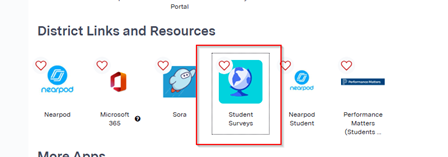
Student Survey: Students can access the survey through the Student Survey Module in Clever. To increase response rates, we encourage you to work with your teachers to set aside time for students to complete their surveys during school hours.
Parents/Students
A student must have been enrolled for at least 40 days to receive a survey.
Students and parents will be asked to provide feedback on each individual course/teacher they have, as well as the administrators in their building.
They may skip any sections they wish
Parents with multiple children in the district may receive separate survey emails for each child.
Class information is pulled from PowerSchool, so if a student is in an afterschool program or a class that they know by a different name than what is in PowerSchool, please help them determine which class that is (i.e. After School might be Chess Club).
Any questions can be directed to the Assessment Supervisor, Dr. Patrick Jefferies (patrick.jefferies@slcschools.org).
this year's Utah School Public Relations Association conference — aka the 2026 USPRA Annual Conference — USPRA Live: Turning Up the Volume on School PR — will be held this year at Hawthorne Elementary. I launched this conference last year, with Emma as one of the Co-Charis. This year, Emma is co-chairing again (that's why she's cc'd), and the conference has expanded to TWO days:
Conference Details
Thursday, April 23 • 9:00 a.m.–5:00 p.m. Friday, April 24 • 9:00 a.m.–3:00 p.m. Hawthorne Elementary — 1675 S 600 E, Salt Lake City
Another thing that's new this year is a specific track for School Administrators (Administrator Amplifier — NEW Principal/Admin Track). The sessions for the Administrator track will be held on Thursday and focus on practical communication tools, leadership alignment, and strengthening collaboration with school PR professionals.
Best of all, it's FREE for principals to attend!
I realize you have DLC on Thursdays, but would it be possible to invite our school administrators to attend afterwards?
Why Attend
This conference is designed to help school leaders and communication teams:
Elevate communication strategies
Strengthen consistent districtwide messaging
Build trust and engagement with families, staff, and communities
Learn from school PR professionals and leaders across the state
Administrators can register for free using the code UTAPRINCIPAL.
We would love to have as many of our SLCSD administrators join us as we continue to “turn up the volume” on school PR. Please reach out if you have any questions.
To establish a transparent, data-informed, and equity-driven system through which school leaders may formally request additional resources based on identified student needs and strategic priorities.
Guiding Principles
Alignment with district priorities: SLCSD Priorities 2025-26- Our top priorities highlighted from our strategic plan for student success.
Equity over equality: Resources are allocated based on student need rather than equal distribution (Gorski, 2013).
Student-centered decision-making: Requests should reflect actual enrollment, demographic shifts, and the academic or behavioral needs of students (Leithwood, 2010).
Support for diverse learners: Prioritization is given to schools serving high numbers of multilingual learners, students with disabilities, and those in under-resourced communities.
Transparency and accountability: A collaborative process with stakeholder involvement and clear communication throughout.
Petition Submission Process
Step 1: Review school data that serves as the basis for request
Review current school-level data with your area director:
Academic performance
Behavior trends
Enrollment patterns
Staffing ratios
Facility needs
School Data Point
Who to contact if you have questions about accuracy or need additional clarity
Academic Performance
Dr. Patrick Jefferies, Supervisor, Data & Assessment or Dr. Christine Marriott, Director of Title I and School Improvement
Behavior Trends
Dr. Allison Martin, Director of SEL & Preventive Services
Enrollment Patterns
Sam Quartz, Chief Information Officer
Staffing Ratios
Logan Hall, Executive Director, Human Resources or his designee
Facility Needs
Isaac Astill, Executive Director, Auxiliary Services
Explanation of alignment with school and district strategic goals
Step 3: Area Director review
Schedule a consultation to review your petition with your Area Director.
Revisions or recommendations may be made to strengthen alignment or clarify outcomes.
Once approved by the Area Director, it will proceed to the District Review Process,
District Review Process
Step 4: Cabinet-Level review
After the deadline, a cross-functional Cabinet committee will evaluate requests using the Weighted Resource Allocation Formula (see below) and determine feasibility and alignment with district-wide initiatives.
Step 5: Communication of decision
A formal written response will be provided in accordance with the annual timeline.
If approved, a deployment timeline and point-of-contact will be shared.
If declined, the rationale will be explained and next steps will be offered for support and/or resubmission.
Weighted Resource Allocation formula
To ensure fairness and transparency, each petition will be evaluated using the following scoring system (Total Possible: 100 points):
Factor
Weight
Description
Student Enrollment and Demographics
25 points
Proportion of high-need students (e.g., FRL, ELL, SPED)
Academic & Behavioral Data
20 points
Evidence of gaps in achievement, chronic absenteeism, or behavior challenges
Access Impact
20 points
Degree to which resource addresses disparities or underserved student groups
Alignment with Strategic Goals
15 points
How well the request aligns with district/school improvement priorities
Stakeholder Engagement
10 points
Involvement of parents, staff, and community in needs assessment and planning
Feasibility & Sustainability
10 points
Practicality of implementation and potential for sustained impact
Minimum threshold for consideration: 65 points
Implementation & Monitoring
Step 6: Review & Feedback
Relevant staff will review resource allocation with building staff.
Step 6: Resource deployment
Work collaboratively with the assigned district departments (e.g., HR, Finance, Facilities, SPED) to implement the resource as planned.
Step 7: Evaluation & reporting
Monitor effectiveness using outcome data and feedback tools.
Submit a mid-year and end-of-year report summarizing impact.
Adjustments may be made as necessary for sustainability.
Ongoing support and improvement
School Leadership & Support will maintain a log of all approved petitions for transparency.
Annual reviews of the process will be conducted by Cabinet to assess equity and efficiency.
Principal feedback will directly inform system refinements.
Annual timeline will be distributed by School Leadership & Support by September 15th of each year.
Final Note
We thank you for your dedication to equity, excellence, and innovation. This process is not simply about resource distribution—it is about recognizing the unique stories of your schools and responding with meaningful support. Together, we will ensure every student in Salt Lake City School District receives the opportunities they deserve to learn, grow, and succeed.
For questions or additional support with your resource petition, please contact your Area Director or the Office of School Leadership & Support.