Skip to content

Summary:

The School Improvement Plan (SIP) Review Process is designed to support high-quality planning across all schools while promoting clarity, consistency, and continuous improvement. This process reflects our shared commitment to data-informed decision-making, equitable student outcomes, and alignment with district priorities. By establishing clear expectations and a common rubric, the SIP review process ensures that every school receives meaningful feedback and differentiated support based on plan readiness. Most importantly, the process emphasizes partnership and growth, providing principals and leadership teams with guidance, transparency, and targeted assistance to strengthen implementation and improve outcomes for students.

Purpose

  • Ensure every School Improvement Plan is clear, data-driven, and aligned to district priorities.
  • Provide transparent expectations for SIP quality.
  • Differentiate review and support based on plan readiness.

Annual SIP Timeline

  • Spring–Early Fall: Schools analyze data and develop SIPs using the district template.
  • Submission Deadline: Principals submit SIPs to the district.
  • Rubric Review: All SIPs are reviewed using the District SIP Rubric.
  • Approval & Feedback: Schools receive approval or revision guidance.

SIP Review Rubric Overview

All SIPs are reviewed using a common rubric to ensure consistency across schools. Each domain is scored on a 1–4 scale.

Rubric Domains

  • Needs Assessment & Data Analysis
  • Goals & Measurable Outcomes
  • Strategies & Action Steps
  • Equity & Student Support
  • Implementation Capacity
  • Monitoring & Continuous Improvement

Scoring Scale

  • 4 – Exemplary: Clear, aligned, and ready for implementation.
  • 3 – Meets Expectations: Solid plan with minor refinements needed.
  • 2 – Approaching Expectations: Key components present but require revision.
  • 1 – Does Not Meet Expectations: Significant gaps requiring support.

Review Pathways

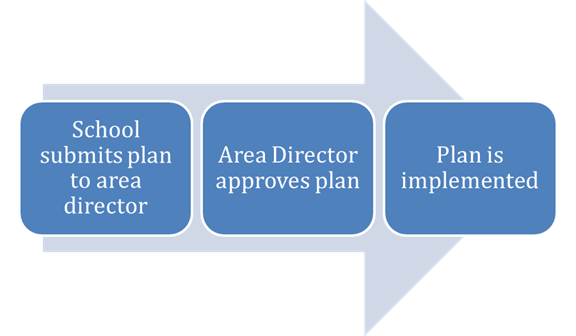
Pathway 1: Area Director Review & Approval

  • Eligibility: Schools that meet state threshold and meet the district threshold (e.g., 18/24) with no domain below a 3.
  • Area Director reviews the SIP and provides written feedback and approves plan.
  • Principals make any minor revisions requested.
  • Final approval is granted by the Area Director.

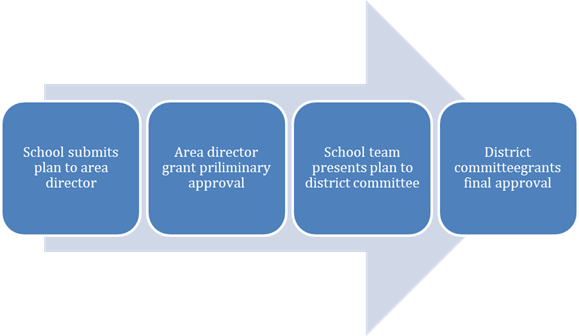
Pathway 2: District-Level Committee Review

  • Eligibility: SIP does not meet the state threshold.
  • Area Director reviews the SIP and provides written feedback and approves plan.
  • A district committee conducts a deeper review.
  • Principals and their leadership teams participate in a presentation to clarify processes, strategies, needs and expectations.
  • In necessary, specific revisions and timelines are provided, along with district supports.
  • After revisions, the revised SIP is approved.

Monitoring & Ongoing Support

  • All schools submit periodic progress updates aligned to SIP goals.
  • Area Directors monitor implementation and outcomes.
  • Schools receiving additional support may have scheduled check-ins and targeted coaching.

What Principals Should Expect

  • Clear expectations and consistent feedback.
  • Timely communication regarding review status.
  • Support aligned to identified needs.
  • A focus on continuous improvement rather than compliance.


SLCSD School Improvement Plan (SIP) Review Process

This process outlines the submission and approval process for the school improvement plans for schools in Salt Lake City School District.

For a plan to have been deemed successful, the school must meet the state established threshold of either an 1% growth as measured by the accountability metrics or the following points on the accountability metrics:

  • Elementary/Middle School – 43.5% or higher
  • High School –46% or higher

Flow Chart(s):

School Meets Threshold


School Does Not Meet Threshold


Salt Lake City School District
School Improvement Plan (SIP) Rubric

This rubric is aligned to the SLCSD Strategic Plan for Student Achievement (2024–2029) and supports consistent, equity-centered review of School Improvement Plans.

DomainStrategic Plan Alignment1 – Needs Revision2 – Developing3 – Proficient4 – Exemplary
Data Analysis & Root CauseAll Pillars; emphasis on Pillar 1 & 2    
Goals & OutcomesAligned to Pillar Goals and Board Targets    
Strategies & Action StepsPillars 1–4 as applicable    
Equity & Student SupportPillar 1: Equity, Access, Student Support    
Implementation & MonitoringAll Pillars; Continuous Improvement    


Overall Score: ______ / 20

Meets Area Director Approval Threshold?  ☐ Yes   ☐ No

Reviewer Comments:

Please review the guidelines below for dropping students due to consecutive unexcused absences. Requirements differ for General Education and Special Education students. 

1. General Education Students 

Drop Timeline: A general education student should be dropped on Day 11, after 10 consecutive unexcused absences. 

Required Actions: Complete at least one documented intervention before dropping the student. 

Acceptable interventions include: 

·  Phone calls 

·  Text messages 

·  Emails 

·  Home visits 

Document all outreach in PowerSchool. 

2. Special Education Students 

Drop Timeline: A student with an IEP should be dropped on Day 31, after 30 consecutive unexcused absences. 

Required Actions: 

· Special education teachers must document all attempts to connect with the family. 

· Email all documentation to Erin Anderson. 

· Fill out the 10-day Ready and Willing Letter FORM document at 10 days of consecutive, unexcused absences. 

· Complete the SCRAM link on the DDC. 

· Exit the student using code UN. 

If you have any questions or need further assistance, please reach out to Dr. Bri Conley (Bri.Conley@slcschools-org )

Creating a Supportive Environment for Muslim Staff and Students During Ramadan."

Ramadan is a special time of spiritual reflection, fasting from dawn to sunset, and increased devotion for Muslims. As a school community, it’s important to foster a welcoming and inclusive atmosphere for Muslim staff and students during this period. Here are some helpful guidelines to ensure everyone feels supported:

  1. Understand Ramadan and Its Practices
    • Fasting: Muslims refrain from eating, drinking (including water), and sometimes taking medications from dawn (Fajr) until sunset (Maghrib). The fast is typically broken with a meal called Iftar.
    • Prayer: In addition to the five daily prayers, many Muslims also participate in extra prayers called Taraweeh during the evening. This may lead to less sleep, so it’s important to be mindful of its potential impact on energy levels.
    • Eid al-Fitr: Ramadan concludes with the celebration of Eid al-Fitr, marked by prayers, family gatherings, and festivities. Muslim staff and students may request time off for this important holiday.
  2. Foster a Flexible and Understanding Environment
    • Prayer Accommodations: Provide a quiet and private space for Muslim staff and students to pray during the day. Keep in mind that prayer times vary slightly based on the position of the sun.
    • Flexible Scheduling: Consider offering flexible schedules for fasting staff and students. Whenever possible, avoid scheduling exams, presentations, or physically demanding activities late in the day when energy levels may be lower.
    • Classroom Sensitivity: When planning classroom activities, such as parties or food-related events, be mindful of students who are fasting and create an environment where they feel comfortable.
  3. Offer Alternatives for Physical Activities
    • PE Classes: For students who are fasting and may feel tired, allow them to opt-out of physically strenuous activities or participate in modified exercises.
    • Recess: Younger students who are fasting may prefer to engage in quieter activities during recess. Offer an indoor space where they can rest if needed.
  4. Consider Lunch and Eating Spaces
    • Respectful Lunchtime Environment: For students who are fasting, offer a quiet space, such as a library or designated room, where they can spend lunchtime if they prefer to avoid the cafeteria.
    • Staff Breaks: For fasting staff members, ensure they have access to private spaces where they can rest or pray during lunch breaks.
  5. Promote Inclusivity and Awareness
    • Community Education: Consider offering brief educational sessions or sharing resources about Ramadan to foster understanding and empathy within the school community.
    • Avoid Assumptions: Not all Muslims observe Ramadan in the same way. Some may not fast due to medical reasons or personal circumstances. Always respect individual choices and allow staff and students to participate as they see fit.
  6. Accommodate for Eid al-Fitr
    • Time Off for Eid: Make sure Muslim staff and students can take time off to celebrate Eid al-Fitr. Encourage them to communicate their needs in advance to plan accordingly.
    • Schoolwide Acknowledgement: Consider recognizing Eid al-Fitr through announcements or newsletters, promoting inclusivity and respect for religious diversity within the school.
  7. Communicate and Offer Support
    • Open Dialogue: Encourage Muslim staff and students to share any specific needs or accommodations they may require during Ramadan. Ensure that everyone feels comfortable discussing their needs with teachers and administrators.
    • Supportive Tone: Lead with a positive and welcoming tone, making it clear that the school is committed to fostering an inclusive and respectful environment for all religious observances.

By following these steps, the school can create a respectful, supportive, and inclusive atmosphere during Ramadan, showing genuine care for religious diversity and the well-being of all members of the school community.

Date:                  January 29, 2026

To:                  All Administrators

From:              April Reynold, Co-Teaching Administrator on Special Assignment

Dr. Tiffany Hall, Executive Director, Teaching and Learning

Summary:

The SLCSD Co-Teaching Cohort will bring administrators together to build a shared understanding of effective co-teaching models and how they support inclusive, high-quality instruction.

During four sessions of school visits and collaborative discussion, leaders will examine strong co-teaching practices already in place across the district, reflect on scheduling and staffing structures that make them successful, and begin identifying conditions that support effective implementation at their own schools.

The cohort is designed to support thoughtful dialogue, learning from peers, and practical next steps for strengthening co-teaching in SLCSD.

Who should come?

Principals and assistant principals who are interested in learning more about co-teaching models and practices that are working in SLCSD

What is the structure?

Four sessions:

  • Intro to Co-Teaching Models and Opportunities
  • School Visit – Scheduling for Success
  • School Visit – Specially Designed Instruction
  • Planning and Next Steps

When does it start?

  • Elementary: February 9, 1:30 –2:30 PM​
  • Secondary: March 3, 1:30 – 2:30 PM​
  • Subsequent dates determined at the first meeting​
  • Expect learning sessions to be 60 minutes, school visits 2-2.5 hours​

Register for Co-Teaching Cohorts – Click Here

Dear Principals,

In our ongoing effort to ensure all students receive the support they need to thrive, we are pleased to introduce a clear and supportive procedure for requesting additional resources that will govern all future requests for additional resources. This process is grounded in the principles of equity, student-centered decision-making, and shared accountability. Your voice and leadership are essential in helping us meet the diverse and evolving needs of our school communities.

Purpose of the Process

To establish a transparent, data-informed, and equity-driven system through which school leaders may formally request additional resources based on identified student needs and strategic priorities.

Guiding Principles

  • Alignment with district priorities:  SLCSD Priorities 2025-26  - Our top priorities highlighted from our strategic plan for student success.
  • Equity over equality: Resources are allocated based on student need rather than equal distribution (Gorski, 2013).
  • Student-centered decision-making: Requests should reflect actual enrollment, demographic shifts, and the academic or behavioral needs of students (Leithwood, 2010).
  • Support for diverse learners: Prioritization is given to schools serving high numbers of multilingual learners, students with disabilities, and those in under-resourced communities.
  • Transparency and accountability: A collaborative process with stakeholder involvement and clear communication throughout.

Petition Submission Process

Step 1: Review school data that serves as the basis for request

  • Review current school-level data with your area director:
    • Academic performance
    • Behavior trends
    • Enrollment patterns
    • Staffing ratios
    • Facility needs
School Data PointWho to contact if you have questions about accuracy or need additional clarity
Academic PerformanceDr. Patrick Jefferies, Supervisor, Data & Assessment or Dr. Christine Marriott, Director of Title I and School Improvement
Behavior TrendsDr. Allison Martin, Director of SEL & Preventive Services
Enrollment PatternsSam Quartz, Chief Information Officer
Staffing RatiosLogan Hall, Executive Director, Human Resources or his designee
Facility NeedsIsaac Astill, Executive Director, Auxiliary Services

Step 2: Draft a resource petition

  • Complete the District Resource Petition, which includes:
    • Description of the requested resource(s)
    • Supporting data (quantitative and/or qualitative)
    • Expected impact on student outcomes
    • Explanation of alignment with school and district strategic goals

Step 3: Area Director review

  • Schedule a consultation to review your petition with your Area Director.
  • Revisions or recommendations may be made to strengthen alignment or clarify outcomes.
  • Once approved by the Area Director, it will proceed to the District Review Process,

District Review Process

Step 4: Cabinet-Level review

After the deadline, a cross-functional Cabinet committee will evaluate requests using the Weighted Resource Allocation Formula (see below) and determine feasibility and alignment with district-wide initiatives.

Step 5: Communication of decision

  • A formal written response will be provided in accordance with the annual timeline.
  • If approved, a deployment timeline and point-of-contact will be shared.
  • If declined, the rationale will be explained and next steps will be offered for support and/or resubmission.

Weighted Resource Allocation formula

To ensure fairness and transparency, each petition will be evaluated using the following scoring system (Total Possible: 100 points):

FactorWeightDescription
Student Enrollment and Demographics25 pointsProportion of high-need students (e.g., FRL, ELL, SPED)
Academic & Behavioral Data20 pointsEvidence of gaps in achievement, chronic absenteeism, or behavior challenges
Access Impact20 pointsDegree to which resource addresses disparities or underserved student groups
Alignment with Strategic Goals15 pointsHow well the request aligns with district/school improvement priorities
Stakeholder Engagement10 pointsInvolvement of parents, staff, and community in needs assessment and planning
Feasibility & Sustainability10 pointsPracticality of implementation and potential for sustained impact

Minimum threshold for consideration: 65 points

Implementation & Monitoring

Step 6:  Review & Feedback

Relevant staff will review resource allocation with building staff.

Step 6: Resource deployment

Work collaboratively with the assigned district departments (e.g., HR, Finance, Facilities, SPED) to implement the resource as planned.

Step 7: Evaluation & reporting

  • Monitor effectiveness using outcome data and feedback tools.
  • Submit a mid-year and end-of-year report summarizing impact.
  • Adjustments may be made as necessary for sustainability.

Ongoing support and improvement

  • School Leadership & Support will maintain a log of all approved petitions for transparency.
  • Annual reviews of the process will be conducted by Cabinet to assess equity and efficiency.
  • Principal feedback will directly inform system refinements.

Supporting Tools

Final Note

We thank you for your dedication to equity, excellence, and innovation. This process is not simply about resource distribution—it is about recognizing the unique stories of your schools and responding with meaningful support. Together, we will ensure every student in Salt Lake City School District receives the opportunities they deserve to learn, grow, and succeed.

For questions or additional support with your resource petition, please contact your Area Director or the Office of School Leadership & Support.

This information was originally sent on 12/6/2022 in the Letters for Leadership v.18.  Please note the following:

 Winter Weather Guidelines

We want to ensure that you are aware of the expectations for the chilly time of the school year.   Please reach out to you community and communicate to parents that students should be dressed and prepared for the cold weather with the following items: warm coats, sweaters/ hoodies, boots, hats, scarves, mittens/gloves, etc. Please ensure that these items are marked in case they are misplaced or lost. Students should come prepared to go outside, get some fresh air, and exercise outdoors daily.  The exceptions to going out daily are listed below:

Morning:

  • Inside morning in the gym, IF there is significant rainfall or snowfall. (IF students will be getting wet outside.)
  • Inside morning in the gym, IF the temperature is below 20 degrees.
  • Students sitting on their pockets, not running around, playing sports, etc.
  • Inside mornings are from (List the time for your school)________ to ensure our outside-duty teachers are in the gym to help supervise.

Recess:

  • Teacher/Grade Level Discretion
  • Inside recess IF the temperature is below 20 degrees. Recess time is held inside the classroom.

Lunch Recess:

  • Admin/Office Discretion
  • Inside lunch recess, IF there is significant rainfall or snowfall (If students will be getting wet outside), recess time is held inside the classroom.
  • Inside lunch recess, IF the temperature is below 20 degrees, recess time is held inside the classroom.

Please reach out if you have any questions or need further information.  Thank you for all that you do for the children of our district.

From: Terrilyn Lee

Hello Test Coordinators,

Just a quick note to update you on what is new with RISE, though I did include the new parent resources for our other state required tests.  Please share this information with your teachers.

  1. USBE has added Parent Resources to all the USBE Assessment pages
  1. New Cut scores for ELA have been released  RISE-Score-Charts_2025_updated.pptx Please note, due to the significant changes in the ELA test, please do not compare last year’s results to this years at a scaled score level.
  2. Please note; All RISE Individual Student reports for ELA, Writing, Math and Science are available to families in the PowerSchool parent portal.
  3. The new writing reporting has 2 categories
    • Composition (argument/informative): Scale of 1-6
    • Conventions: Scale of 0.5-3
    • The two scores are not intended to be added together.
  4. New Writing benchmark modules and ELA interim are available in RISE Test Administration
    • Most grades have multiple writing benchmarks available with fully automated scoring.
    • Grade 7 informative writing benchmarks still need more students to participate in the field test before automatic scoring is available.  Field testing for 7th grade informative will open again in February.
  5. NEW Feature Update on the RISE calculator in math and science.  Students can now copy-paste their answers directly from the onscreen calculator into the response field.  This feature is available:
    • On all Math and Science RISE assessments where calculators are provided onscreen
    • For all onscreen calculator types (basic, scientific, graphing)
    • Only for Equation Response items where a student must enter a numerical answer
  1. USBE RISE Training is available https://youtu.be/JZUKTw6m38c?si=Y-eZsh2A19rroY9M
  2. New Utah Accessibility, Accommodations, and Participation Policy 2025–2026  Check out the Appendixes.  There is an Appendix specific to each test which is divided into 2 sections.  The first section are the tools and supports available for ALL students, the second section are the additional accommodations allowed for students if they are listed on their IEPs or 504s.  Please note, some must be approved by either the state or district before they can be activated for students.   RISE is Appendix J, pp 67-69

If you have questions, please don’t hesitate to contact me.

From: Analis Carattini-Ruiz

Dear Principals:

Help Us Improve School Registration

We're working to improve our school registration systems and would love input from different members of our school community.

Over the next few weeks, we’ll be sending out surveys and hosting focus groups with families, school office staff, and district support teams (like McKinney-Vento, Special Education, Counseling, etc.) to learn more about their experiences with registration.

We’d appreciate your help identifying school staff and parents who might be willing to participate and share their feedback.

Here are the upcoming focus group dates:

  • Parents:
    • Liberty CLC: October 27 at 4:30 PM
    • Glendale CLC: October 28 at 4:30 PM
  • District Support Staff:
    • In-person meeting with Sam: October 22 at 1:00 PM
  • School Staff:
    • Virtual Zoom meeting: October 22 at 3:30 PM

To reiterate: we need the names of potential participants— we’ll take care of sending the invitations.

Please send the names of recommended school staff and families to Sam Quantz, Dr. Bri Conley, Yándary Chatwin, and Dr. Analis Ruiz by October 15, 2025.

Thank you so much — we truly appreciate your support!

Analis Carattini-Ruiz, Ph.D. 

Associate Superintendent

801-578-8347

analis.carattini-ruiz@slcschools.org

Excellence and Equity: every student, every classroom, every day

Learn more about our work:

The Salt Lake City School District: Prioritizing Literacy, Pathways, and Attendance

Advancing a culture of dignity—the Salt Lake City School District way

Scholarship for Teachers

Are you interested in teaching Concurrent Enrollment classes at your high school but are not qualified? Do you want to take the college classes so you are qualified? What if we pay for the tuition? 

Let's jump in!

We are excited to offer an opportunity to pay for your tuition to take a class (or two, not an entire Master's degree) to become qualified to teach concurrent enrollment. 

Apply Here!

If you don't know if you are qualified or want to have a conversation about offering additional concurrent enrollment classes, please reach out to your CTE Coordinator or the Business Development Coordinator: 

Julianna Wing, CTE Business Development Coordinator 

Anne Martin, CTE Coordinator, East High School 

Emily Grass, CTE Coordinator, Highland High School 

Sarah Wilson, CTE Coordinator, West High School 

STUDENT SERVICES NEWS

Monthly Newsletter September 2025

Happenings

  • September is Suicide Prevention Month Please share the Parent Guidance Mental Health Series resource with parents: including  Parent Guidance Online Mental Health Newsletter  and  "What Parents Need to Know about Suicide Prevention"
  • Thank you to the schools that have already scheduled and implemented regular mental health meetings!
  • Anti-Harassment/Anti-Bullying Student Training is being facilitated by school counselors now through October 1st. The Procedures for Training and Reporting are in the Document Center.
  • All Schools will receive $1000 for Suicide Prevention. Admin, please support implementation of the suicide prevention program at your schools and ensure these funds are being utilized to strengthen it.
  • Insight The Prime for Life and Guiding Good Choices schedule is now available. To see the schedule and register please click here 
  • Peer Court begins on October 6th. Referrals can be submitted here.  
  • Optional Admin/SRO Gun Safety and Active Shooter Training at East High School Library September 26th from 9:00am to 3:00pm RSVP HERE
School Counselors
Student Services Meeting (Virtual) September 17 from 9-12.  All Counselors, Social Workers, Nurses and McKinney Staff attend. Admin are always welcome.

Agendas and resourcesStudent Services Meetings 2025-2026  

Secondary Counselor Program: 
• All Secondary Counseling Programs will be reviewed by USBE this Spring to ensure adherence to state counseling standards. This program review nets counselor support budgets at secondary schools.
On-Site Review Performance Evaluation  Data Project Reports  Counselors must present data projects during a staff meeting. If presentations did not occur last Spring, please schedule asap.
Updates and Essentials Training  All secondary administrators who have not completed this USBE school training within the past six years must complete the course asap. Documentation of completion will need to be provided to the state in March.

Elementary Counselor Program:
Elementary Counselor folder for resources, training materials, and PowerPoints from elementary counselor breakout sessions of Student Services meetings.
Bullying One-Sheet outlines anti-bullying and anti-harassment policies and provides resources to families
Utah Crisis and Suicide Prevention Resources Submit G19-20 documentation by Oct. 1 to this Microsoft link
• Elementary Counselors submit monthly data using this Microsoft formElementary Counselor Annual Task Organizer
SLCSD Elementary Counselor Handbook
• Revised Counselor ECAP and Observation Tool

Helpful Links:
3rd Millennium Substance Violation Option for Secondary Students
Counselor Handbooks
Counselor Document Center
Utah College Application and FAFSA Resources
Digital Awareness: Classroom Curriculum
District Social Work and Mental Health Partnerships
Social Work Services 
We are excited to welcome Andrea Carrizo, Annie Romano, Haref Montalvo, Jessica Carpenter and Yvette Orr to our team!
• Social workers are conducting mental health screening at all school sites.
• Thank you to the schools that have already implemented and scheduled regular mental health meetings!

Odyssey House
• Salt Lake City School District partners with Odyssey House to provide free school-based therapeutic services to students at East, Highland, Horizonte, Backman and Parkview.

Helpful Links:
Mental Health Screening
Parent Guidance Mental Health Series
Social Work Handbook    
Health Services
Important items this month:
Vision Screening starts on September 16, 2025.
CPR/AED/Narcan training continue to be offered once a month at the district office building.  If you would like to be certified or your certification has expired, sign up for a class.
-Remember, schools must have at least three front office staff CPR certified to have an AED in the school.
--Elementary: Kinder, 1st, 2nd, 3rd, 5th and special request.
--Middle: 7th grade and any special request.

Helpful Links:
How to access Healthcare Plans
Sick Room Protocol
Guidelines for Illness
Health Services School Assignments and Resources
McKinney Vento
Important items this month:
Welcome Cisco Ramos our new McKinney Team member
Housing Questionnaire: This form activates supports for qualifying students. Email completed forms to Becky Baskett and Mike Harman
- See District Documents Center for translated forms.
- See McKinney List in PowerSchoolhomeless_code>0 - If students you know qualify and are not on the list, complete the Housing Questionnaire link above
Reminder: McKinney-Vento eligible students can enroll without proof of address, immunization records, and/or birth certificate
• Reach out to the McKinney Vento team for student support, questions and/or staff training.

Helpful Links:
McKinney Vento Resources  
School Resource Officers
Important items this month:
If you need an SRO for any reason:
• Call your school assigned SRO (if no response)
• Call Sgt. Doug Teerlink 385-228-8072 (if no response)
Call dispatch for non-emergency 801-799-3000
Call 911 in an emergency
Peer Court
Promising Youth Gang Prevention and Intervention Contact Krystyn Stargel 385-312-3104 regarding referrals or click links below.

Helpful Links:
SRO School Assignments
Promising Youth & Promising Youth Referral
Peer Court Referral            
Protected By
Shield Security