Subject: Utah Jazz + Utah Mammoth Launch New “Assist for Good” Student Grant Opportunity – Applications Due March 20
We are excited to share a new opportunity for your students through the SEG Foundation. We hope that you pass this along to the principals at your middle, junior and high schools. Today we launched the “Assist for Good” Grant Program, which empowers junior high and high school students across Utah to create meaningful, student-led change within their school communities.
Through this program, students are invited to submit an application outlining an action plan to address a specific need at their school. Selected schools may receive up to $2,000 in grant funding to bring their student-driven project to life during the remainder of the 2025–26 school year.
Projects may focus on areas such as:
Student wellness
Inclusion initiatives
Campus improvements
Service projects
Other programs that create lasting, positive impact
Applications are due March 20, 2026. Interested students can apply here.
Students from each winning school will also be invited to attend either the March 23, Utah Mammoth game or the March 30, Utah Jazz game, where they will be recognized for their commitment to uplifting their school community.
We would love your help in sharing this opportunity with school leaders, student leaders, clubs, councils, and other groups who may be interested in proposing a project. This is a wonderful chance for students to practice leadership, collaboration, and service while making a real difference in their schools.
Thank you for all you do to support and inspire your students. Please feel free to reach out to me or segfoundation@teamseg.com with any questions.
The School Improvement Plan (SIP) Review Process is designed to support high-quality planning across all schools while promoting clarity, consistency, and continuous improvement. This process reflects our shared commitment to data-informed decision-making, equitable student outcomes, and alignment with district priorities. By establishing clear expectations and a common rubric, the SIP review process ensures that every school receives meaningful feedback and differentiated support based on plan readiness. Most importantly, the process emphasizes partnership and growth, providing principals and leadership teams with guidance, transparency, and targeted assistance to strengthen implementation and improve outcomes for students.
Purpose
Ensure every School Improvement Plan is clear, data-driven, and aligned to district priorities.
Provide transparent expectations for SIP quality.
Differentiate review and support based on plan readiness.
Annual SIP Timeline
Spring–Early Fall: Schools analyze data and develop SIPs using the district template.
Submission Deadline: Principals submit SIPs to the district.
Rubric Review: All SIPs are reviewed using the District SIP Rubric.
Approval & Feedback: Schools receive approval or revision guidance.
SIP Review Rubric Overview
All SIPs are reviewed using a common rubric to ensure consistency across schools. Each domain is scored on a 1–4 scale.
Rubric Domains
Needs Assessment & Data Analysis
Goals & Measurable Outcomes
Strategies & Action Steps
Equity & Student Support
Implementation Capacity
Monitoring & Continuous Improvement
Scoring Scale
4 – Exemplary: Clear, aligned, and ready for implementation.
3 – Meets Expectations: Solid plan with minor refinements needed.
2 – Approaching Expectations: Key components present but require revision.
1 – Does Not Meet Expectations: Significant gaps requiring support.
Review Pathways
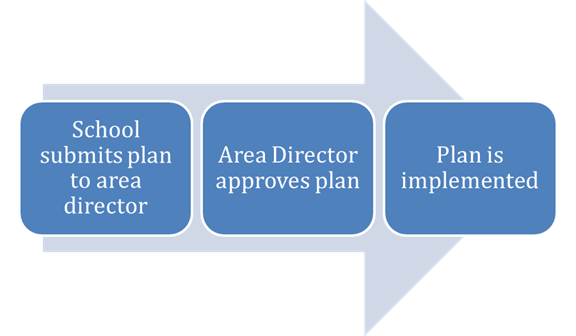
Pathway 1: Area Director Review & Approval
Eligibility: Schools that meet state threshold and meet the district threshold (e.g., 18/24) with no domain below a 3.
Area Director reviews the SIP and provides written feedback and approves plan.
Principals make any minor revisions requested.
Final approval is granted by the Area Director.
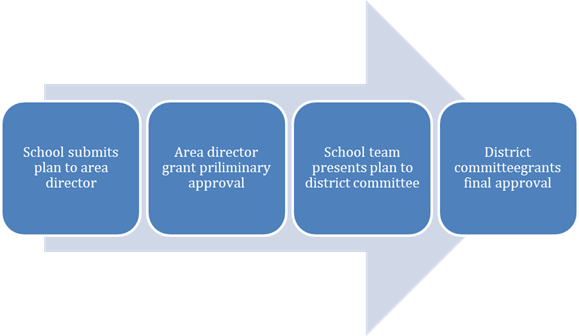
Pathway 2: District-Level Committee Review
Eligibility: SIP does not meet the state threshold.
Area Director reviews the SIP and provides written feedback and approves plan.
A district committee conducts a deeper review.
Principals and their leadership teams participate in a presentation to clarify processes, strategies, needs and expectations.
In necessary, specific revisions and timelines are provided, along with district supports.
After revisions, the revised SIP is approved.
Monitoring & Ongoing Support
All schools submit periodic progress updates aligned to SIP goals.
Area Directors monitor implementation and outcomes.
Schools receiving additional support may have scheduled check-ins and targeted coaching.
What Principals Should Expect
Clear expectations and consistent feedback.
Timely communication regarding review status.
Support aligned to identified needs.
A focus on continuous improvement rather than compliance.
SLCSD School Improvement Plan (SIP) Review Process
This process outlines the submission and approval process for the school improvement plans for schools in Salt Lake City School District.
For a plan to have been deemed successful, the school must meet the state established threshold of either an 1% growth as measured by the accountability metrics or the following points on the accountability metrics:
Elementary/Middle School – 43.5% or higher
High School –46% or higher
Flow Chart(s):
School Meets Threshold
School Does Not Meet Threshold
Salt Lake City School District School Improvement Plan (SIP) Rubric
This rubric is aligned to the SLCSD Strategic Plan for Student Achievement (2024–2029) and supports consistent, equity-centered review of School Improvement Plans.
Domain
Strategic Plan Alignment
1 – Needs Revision
2 – Developing
3 – Proficient
4 – Exemplary
Data Analysis & Root Cause
All Pillars; emphasis on Pillar 1 & 2
Goals & Outcomes
Aligned to Pillar Goals and Board Targets
Strategies & Action Steps
Pillars 1–4 as applicable
Equity & Student Support
Pillar 1: Equity, Access, Student Support
Implementation & Monitoring
All Pillars; Continuous Improvement
Overall Score: ______ / 20
Meets Area Director Approval Threshold? ☐ Yes ☐ No
To establish a transparent, data-informed, and equity-driven system through which school leaders may formally request additional resources based on identified student needs and strategic priorities.
Guiding Principles
Alignment with district priorities: SLCSD Priorities 2025-26- Our top priorities highlighted from our strategic plan for student success.
Equity over equality: Resources are allocated based on student need rather than equal distribution (Gorski, 2013).
Student-centered decision-making: Requests should reflect actual enrollment, demographic shifts, and the academic or behavioral needs of students (Leithwood, 2010).
Support for diverse learners: Prioritization is given to schools serving high numbers of multilingual learners, students with disabilities, and those in under-resourced communities.
Transparency and accountability: A collaborative process with stakeholder involvement and clear communication throughout.
Petition Submission Process
Step 1: Review school data that serves as the basis for request
Review current school-level data with your area director:
Academic performance
Behavior trends
Enrollment patterns
Staffing ratios
Facility needs
School Data Point
Who to contact if you have questions about accuracy or need additional clarity
Academic Performance
Dr. Patrick Jefferies, Supervisor, Data & Assessment or Dr. Christine Marriott, Director of Title I and School Improvement
Behavior Trends
Dr. Allison Martin, Director of SEL & Preventive Services
Enrollment Patterns
Sam Quartz, Chief Information Officer
Staffing Ratios
Logan Hall, Executive Director, Human Resources or his designee
Facility Needs
Isaac Astill, Executive Director, Auxiliary Services
Explanation of alignment with school and district strategic goals
Step 3: Area Director review
Schedule a consultation to review your petition with your Area Director.
Revisions or recommendations may be made to strengthen alignment or clarify outcomes.
Once approved by the Area Director, it will proceed to the District Review Process,
District Review Process
Step 4: Cabinet-Level review
After the deadline, a cross-functional Cabinet committee will evaluate requests using the Weighted Resource Allocation Formula (see below) and determine feasibility and alignment with district-wide initiatives.
Step 5: Communication of decision
A formal written response will be provided in accordance with the annual timeline.
If approved, a deployment timeline and point-of-contact will be shared.
If declined, the rationale will be explained and next steps will be offered for support and/or resubmission.
Weighted Resource Allocation formula
To ensure fairness and transparency, each petition will be evaluated using the following scoring system (Total Possible: 100 points):
Factor
Weight
Description
Student Enrollment and Demographics
25 points
Proportion of high-need students (e.g., FRL, ELL, SPED)
Academic & Behavioral Data
20 points
Evidence of gaps in achievement, chronic absenteeism, or behavior challenges
Access Impact
20 points
Degree to which resource addresses disparities or underserved student groups
Alignment with Strategic Goals
15 points
How well the request aligns with district/school improvement priorities
Stakeholder Engagement
10 points
Involvement of parents, staff, and community in needs assessment and planning
Feasibility & Sustainability
10 points
Practicality of implementation and potential for sustained impact
Minimum threshold for consideration: 65 points
Implementation & Monitoring
Step 6: Review & Feedback
Relevant staff will review resource allocation with building staff.
Step 6: Resource deployment
Work collaboratively with the assigned district departments (e.g., HR, Finance, Facilities, SPED) to implement the resource as planned.
Step 7: Evaluation & reporting
Monitor effectiveness using outcome data and feedback tools.
Submit a mid-year and end-of-year report summarizing impact.
Adjustments may be made as necessary for sustainability.
Ongoing support and improvement
School Leadership & Support will maintain a log of all approved petitions for transparency.
Annual reviews of the process will be conducted by Cabinet to assess equity and efficiency.
Principal feedback will directly inform system refinements.
Annual timeline will be distributed by School Leadership & Support by September 15th of each year.
Final Note
We thank you for your dedication to equity, excellence, and innovation. This process is not simply about resource distribution—it is about recognizing the unique stories of your schools and responding with meaningful support. Together, we will ensure every student in Salt Lake City School District receives the opportunities they deserve to learn, grow, and succeed.
For questions or additional support with your resource petition, please contact your Area Director or the Office of School Leadership & Support.
As the Superintendent has regularly shared, we are building a district where there is a foundation of similarity among schools. Individual school variations will exist and flourish on that coherent district-wide foundation. With this move towards greater equity, consistency, and transparency in our decision-making process and work, we would like to describe an important shift in our approach.
As an organization, we must consciously base decisions on policy. We must also clearly document our systems and processes so they are accessible and easily understandable. Moving forward, we will all be adopting a policy-driven model that provides consistency for all situations rather than one that relies on personal knowledge or advocacy. School administrators will be supported in making decisions that align with operational processes and can be easily communicated, supported, and defended to our stakeholders.
This approach will:
Build Trust: As we focus on objective, policy-based decisions, stakeholders will have greater confidence in the fairness and impartiality of our actions.
Enhance Transparency: A policy-driven model provides clear guidelines that everyone can follow, ensuring that decisions are open and easily understood by all.
Promote Consistency: By adhering to established policies, we reduce variability in decision-making and ensure that similar situations are handled in a uniform manner across the district.
Foster Accountability: A reliance on policies ensures that decisions are not based on personal biases or relationships, making the rationale behind each decision clear and defensible.
The rationale behind this shift is rooted in our commitment to creating an environment that is fair and consistent. By focusing on policies rather than individual relationships, we can ensure that decisions are aligned with our broader goals and values, and that staff, students, and stakeholders are treated equitably. It enables us to make decisions that are aligned with the best interests of the entire community, ensuring that our actions are guided by fairness and clarity.
Personal relationships will always remain valuable in building strong teams and fostering collaboration. However, an organization as complex as SLCSD needs a structure that ensures that all students, teachers, and administrators are represented in a consistent way. This shift to policy-driven administration creates a robust framework for addressing the district’s complex needs and supports a shared foundation of similarity and cohesiveness.
These practices will support our long-term success and strengthen our collective efforts to provide the best possible educational experience for our students.
Thank you for your ongoing dedication and support as we move forward with this shift. Please reach out with your questions or thoughts.
I hope this message finds you well. I wanted to take a moment to highlight our district’s strong commitment to afterschool programming, which is pivotal in supporting the academic, social, and emotional development of our students.
Afterschool programs offer students the chance to explore interests outside the classroom, engage in enrichment activities, and receive academic support in a safe, structured environment. These programs are vital in creating a sense of belonging, improving academic outcomes, and developing life skills that benefit students well beyond the school day.
In our district, school administrators play a key role in supervising afterschool programs. Their involvement helps create a secure and nurturing environment for students, strengthening their connections with staff outside of regular school hours. This approach elevates the quality of our afterschool programs and promotes stronger collaboration between classroom learning and extended opportunities for growth.
At the Salt Lake City School District, we are fully committed to ensuring our afterschool programs:
Remain accessible to all students, regardless of background or circumstances.
Have ample space across all sites.
Offer a variety of activities that meet the diverse interests and needs of our students.
Provide academic support and enrichment that aligns with our instructional goals.
Inspire student engagement, creativity, and personal growth.
We encourage all staff to actively support and promote these programs, whether through direct involvement, communicating with families, or helping students access these valuable opportunities. Your contributions are critical in ensuring the ongoing success and positive impact of afterschool programming throughout our district.
Please feel free to reach out if you have any questions or suggestions on how we can further enhance our afterschool initiatives.
Thank you for your continued dedication to our students and for helping ensure the success of the Salt Lake City School District.