Some of you may have been contacted by the University of Utah regarding a potential air quality monitoring study.
Executive Director Issac Astill is currently working with the university to put an agreement in place to ensure that neither the school district, individual schools, nor specific locations are published, identified, or referenced in any way in study findings, reports, or external communications.
Once this agreement is finalized, the university professor may reach back out to interested schools to coordinate the placement of the monitoring equipment. Until that time, no commitments or arrangements should be made.
Executive Director Astill will follow up with additional guidance once the agreement is complete.
Thank you for your cooperation, and please feel free to reach out to him with any questions.
To establish a transparent, data-informed, and equity-driven system through which school leaders may formally request additional resources based on identified student needs and strategic priorities.
Guiding Principles
Alignment with district priorities: SLCSD Priorities 2025-26- Our top priorities highlighted from our strategic plan for student success.
Equity over equality: Resources are allocated based on student need rather than equal distribution (Gorski, 2013).
Student-centered decision-making: Requests should reflect actual enrollment, demographic shifts, and the academic or behavioral needs of students (Leithwood, 2010).
Support for diverse learners: Prioritization is given to schools serving high numbers of multilingual learners, students with disabilities, and those in under-resourced communities.
Transparency and accountability: A collaborative process with stakeholder involvement and clear communication throughout.
Petition Submission Process
Step 1: Review school data that serves as the basis for request
Review current school-level data with your area director:
Academic performance
Behavior trends
Enrollment patterns
Staffing ratios
Facility needs
School Data Point
Who to contact if you have questions about accuracy or need additional clarity
Academic Performance
Dr. Patrick Jefferies, Supervisor, Data & Assessment or Dr. Christine Marriott, Director of Title I and School Improvement
Behavior Trends
Dr. Allison Martin, Director of SEL & Preventive Services
Enrollment Patterns
Sam Quartz, Chief Information Officer
Staffing Ratios
Logan Hall, Executive Director, Human Resources or his designee
Facility Needs
Isaac Astill, Executive Director, Auxiliary Services
Explanation of alignment with school and district strategic goals
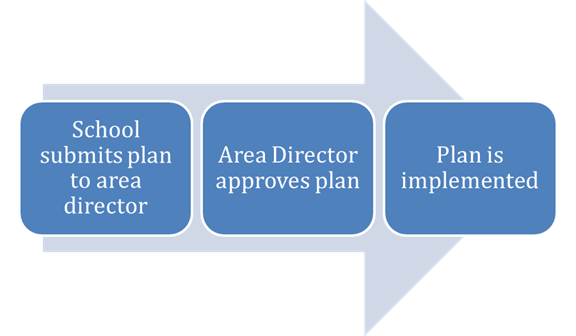
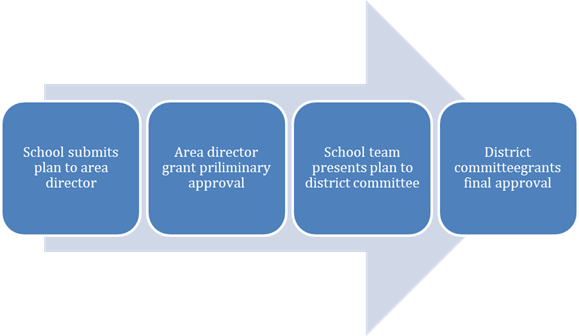
Step 3: Area Director review
Schedule a consultation to review your petition with your Area Director.
Revisions or recommendations may be made to strengthen alignment or clarify outcomes.
Once approved by the Area Director, it will proceed to the District Review Process,
District Review Process
Step 4: Cabinet-Level review
After the deadline, a cross-functional Cabinet committee will evaluate requests using the Weighted Resource Allocation Formula (see below) and determine feasibility and alignment with district-wide initiatives.
Step 5: Communication of decision
A formal written response will be provided in accordance with the annual timeline.
If approved, a deployment timeline and point-of-contact will be shared.
If declined, the rationale will be explained and next steps will be offered for support and/or resubmission.
Weighted Resource Allocation formula
To ensure fairness and transparency, each petition will be evaluated using the following scoring system (Total Possible: 100 points):
Factor
Weight
Description
Student Enrollment and Demographics
25 points
Proportion of high-need students (e.g., FRL, ELL, SPED)
Academic & Behavioral Data
20 points
Evidence of gaps in achievement, chronic absenteeism, or behavior challenges
Access Impact
20 points
Degree to which resource addresses disparities or underserved student groups
Alignment with Strategic Goals
15 points
How well the request aligns with district/school improvement priorities
Stakeholder Engagement
10 points
Involvement of parents, staff, and community in needs assessment and planning
Feasibility & Sustainability
10 points
Practicality of implementation and potential for sustained impact
Minimum threshold for consideration: 65 points
Implementation & Monitoring
Step 6: Review & Feedback
Relevant staff will review resource allocation with building staff.
Step 6: Resource deployment
Work collaboratively with the assigned district departments (e.g., HR, Finance, Facilities, SPED) to implement the resource as planned.
Step 7: Evaluation & reporting
Monitor effectiveness using outcome data and feedback tools.
Submit a mid-year and end-of-year report summarizing impact.
Adjustments may be made as necessary for sustainability.
Ongoing support and improvement
School Leadership & Support will maintain a log of all approved petitions for transparency.
Annual reviews of the process will be conducted by Cabinet to assess equity and efficiency.
Principal feedback will directly inform system refinements.
Annual timeline will be distributed by School Leadership & Support by September 15th of each year.
Final Note
We thank you for your dedication to equity, excellence, and innovation. This process is not simply about resource distribution—it is about recognizing the unique stories of your schools and responding with meaningful support. Together, we will ensure every student in Salt Lake City School District receives the opportunities they deserve to learn, grow, and succeed.
For questions or additional support with your resource petition, please contact your Area Director or the Office of School Leadership & Support.
This information was originally sent on 12/6/2022 in the Letters for Leadership v.18. Please note the following:
Winter Weather Guidelines
We want to ensure that you are aware of the expectations for the chilly time of the school year. Please reach out to you community and communicate to parents that students should be dressed and prepared for the cold weather with the following items: warm coats, sweaters/ hoodies, boots, hats, scarves, mittens/gloves, etc. Please ensure that these items are marked in case they are misplaced or lost. Students should come prepared to go outside, get some fresh air, and exercise outdoors daily. The exceptions to going out daily are listed below:
Morning:
Inside morning in the gym, IF there is significant rainfall or snowfall. (IF students will be getting wet outside.)
Inside morning in the gym, IF the temperature is below 20 degrees.
Students sitting on their pockets, not running around, playing sports, etc.
Inside mornings are from (List the time for your school)________ to ensure our outside-duty teachers are in the gym to help supervise.
Recess:
Teacher/Grade Level Discretion
Inside recess IF the temperature is below 20 degrees. Recess time is held inside the classroom.
Lunch Recess:
Admin/Office Discretion
Inside lunch recess, IF there is significant rainfall or snowfall (If students will be getting wet outside), recess time is held inside the classroom.
Inside lunch recess, IF the temperature is below 20 degrees, recess time is held inside the classroom.
Please reach out if you have any questions or need further information. Thank you for all that you do for the children of our district.
Adventures in Utah Celebrating America 250 Calling All Elementary & Middle School Students
America is turning 250 in 2026! Let’s celebrate by exploring our amazing home — Utah! From red rock canyons to snowy peaks, deserts to pine forests, museums and monuments, — Utah has it all!
What’s in YOUR District 2 backyard or any place you love to visit in Utah? We want to know what YOU discover in Utah while celebrating America’s big birthday! Be creative, be adventurous, and have FUN while honoring the beauty and freedom of our country!
YOUR MISSION:
Get out and explore Utah’s natural wonders, landmarks, parks, museums, and more.
Take a photo of yourself with one of our fun cutouts!
Create a poster showing all the places you've visited.
Snap a photo of your poster and email it to us by the end of the 2026 school year.
Include permission so we can share your adventures online!
Bonus: The more places you explore, the more your adventures will shine! As a special thank you for sharing what you love about Utah, you’ll receive a personal thank-you letter from Congresswoman Celeste Maloy. Keep the adventures coming!
REMEMBER: We live in a country where we are free to explore, to learn, and to connect with the people and places that matter most. America is going to be 250 years old! Show us what you LOVE about America! Show us what you LOVE about Utah
Ready, Set, Explore! We can’t wait to see where your Utah adventures take you! Be sure to bring along either Archie Bryce or Ruby Redrock in your photos as you explore — we’d love to see them by your side in all your Utah snapshots!
Name: [Your Full Name] Email: [your.email@example.com] School: [Full Name of Your District 2 School] Grade: [Your Grade Level] Parent/Guardian Permission: I, [Parent/Guardian Full Name], give permission for my child, [Your Name], to share their work.
America 250 Speech Contest Celebrating 250 Years of America Presented by the Utah U.S. House of Representatives
Calling All High School Students (Grades 9–12)
As we prepare to commemorate 250 years of the United States in 2026, students across Utah's 2nd Congressional District are invited to participate in the America 250 Speech Contest by answering one powerful question:
"What Does America Mean to Me?"
This is your chance to reflect on our country’s values, history, and future — and have your voice heard in a meaningful way.
Important Dates & Deadlines
Contest Opens: August 18, 2025
Submission Deadline: By November 24, 2025
Final Judging: December 2025
U.S. House Floor Reading (District 2): Winning speech to be read by Rep. Maloy – January 2026 (Date TBD)
Utah State Capitol Presentation: Winner and runner-up will present their speeches in person – January 2026 (Date TBD)
Speech Guidelines
Length: 2-minute written speech
Theme: “What America Means to Me”
Format: Written submission (not audio or video)
How to Submit for District 2:
Email your written speech by November 24, 2025, to: America250CM@mail.house.gov Please include:
Full Name
District 2 Location
Email Address
Contact Phone Number
Recognition & Awards
All Participants will receive a Letter of Participation signed by Representative Maloy.
District Winning Speech will be read aloud on the U.S. House Floor in January 2026 by Representative Maloy — a once-in-a-lifetime honor.
Winner & Runner-Up in the district will be invited to present their speeches at the Utah State Capitol in January 2026.
Eligibility
Open to all Utah high school students in grades 9–12 who reside in or attend school in any of Utah’s Congressional Districts. Questions? America250CM@mail.house.gov
For details on how to participate in districts outside of District 2, please contact the respective Congressional office for your Representative.
Thank you for your continued efforts in supporting our students with the NWEA assessments. Attached is the most recent participation chart, which shows where each school currently stands. Our districtwide goal is 95% participation, and the deadline for completion is Friday, September 12, 2025.
Please ensure the necessary arrangements are in place so that all students have the opportunity to participate and we can collectively meet this important target. Your leadership and attention to this matter are greatly appreciated.
This guidance is designed to help school leaders support families with transportation questions, particularly those who live within the state ineligible distance guidelines (less than 1.5 miles for elementary and 2.0 miles for secondary). The process ensures equity, consistency, and compliance with state law, while always prioritizing state-qualified riders.
Key Eligibility Standards
Qualified Riders: Students who live beyond the state thresholds (1.5 miles elementary / 2.0 miles secondary) or who are approved for a documented safety exception.
Unqualified Riders: Students who live within the state thresholds and do not have a safety exception.
Exception Requests
Families who wish to request transportation outside of state eligibility must complete the Salt Lake City School District Transportation Exception Request Form each year.
Important reminders for families:
Approval is subject to available seating and may be revoked at any time if space is needed for state-qualified riders.
No new or relocated bus stops will be created. Students must use existing stops.
Transportation under an exception is a privilege, not a right, and may be revoked for misconduct.
School choice families (students attending outside their boundary) are responsible for their own transportation.
Temporary Ridership During Review
Students may ride temporarily while requests are under review if there is available space.
Temporary ridership does not guarantee approval.
Timing of Requests
No exception or “space available” requests will be reviewed until 15 school days after the start of the year, once average daily ridership counts are established.
This waiting period allows for accurate capacity data.
Approval Criteria
Requests may be approved only if:
The bus route shows at least 10% seating capacity above daily usage.
No state-qualified student is displaced.
Requests are considered first-come, first-served.
Approval is valid for one school year only and must be renewed annually.
Conditions of Ridership
Revocation: Exception riders may lose transportation if capacity is needed for eligible students.
Boundaries: Exception passes do not apply to after-school jobs, activities, or non-boundary placements.
Conduct: Students must follow all bus rules; misconduct may result in loss of transportation privileges.
Communication & Notification
Parents/guardians will receive written notice of approval or denial.
Principals will receive updated rider lists.
Drivers receive weekly rosters and allow boarding temporarily until final determinations are made.
Role of Zūm Pass & Drivers
Every rider must tap their Zūm pass when boarding and exiting.
If a student has no pass:
The driver will allow boarding if the student appears on the approved list.
If unsure, the driver records the student’s details and transports them safely.
Drivers do not deny boarding; Transportation reviews unknown riders after reporting.
How Principals Can Support Families
Direct families to the Transportation Exception Request Form.
Remind families that requests cannot be reviewed until after the 15-day ridership count.
Emphasize that approval is space-dependent and not guaranteed.
Reassure families that safety is always a priority and that all requests are reviewed fairly.
Key Takeaways for Families
Transportation under exception requests is a privilege and not guaranteed.
State-qualified riders always have first priority.
All requests are reviewed consistently and equitably.
The district must balance capacity, safety, and compliance with state regulations.
Please reach out if you have any questions or need further information.
Please integrate the following tasks to your Day One Ready List. We will be sure to get these on the master list in the future. Thanks!
July/August/September Priorities for student services include:
*Secretaries at Training August 4th-Do not schedule it as a registration day.
*Secondary Counselors have 195 day contract—determine the start date for counselors.
*Set up SSC/Counselor meeting to review students with tier 3 needs, cross check schedules, supports, consider parent meeting or home visit prior to school.
*Set-up weekly Counselor Meetings, discuss Counselor Corner for staff meetings, discuss possible staff presentation for PD days.
*Set up your anti-harassment and bullying training dates for students
*Set up Mental Health Screening dates with social workers and counselors
*Set-up regular (weekly suggested) Mental Health Meetings with your district social worker. Schedule a staff presentation.
*Set up a meeting with your school nurse to discuss CPR trained staff requirements, fall staff training, and vision screening
*Secondary set up a meeting with your SRO and PYP advocate.
*Set up a McKinney Meeting with Becky Baskett or Mike Harmon
Must be an assistant principal unless you have a split AP (split APs should be the SSaSS at one of their schools and the other one should assign the position to a counselor or teacher.
Set standing day/time (at least once per week) for SSC meetings
I hope this message finds you well and that your summer planning is off to a strong start.
I’m reaching out with a gentle reminder regarding the importance of timely approval of P-Card transactions. As outlined in Board Policy F-2 and detailed in the P-Card Manual (page 4), principals are responsible for ensuring that all credit card purchases at your site are in full alignment with district purchasing policies and procedures.
When you approve a transaction, you are verifying that this responsibility has been fulfilled. We’ve noticed delays in the approval process, and we want to support all sites in staying current and in compliance.
As noted in the manual, continued non-compliance may result in the loss of P-Card privileges—either for the individual staff member or, in some cases, for the entire site. While we know this is never the intention, we want to be proactive in avoiding those outcomes.
Please take a few moments to ensure your approvals are up to date and that systems are in place to keep them current moving forward. Your attention to this matter is greatly appreciated and helps us maintain fiscal integrity across the district.
Thank you for your leadership and continued partnership.
Each year, the School Safety Plan must be updated to ensure all emergency procedures and school-specific information are accurate and current.
Purpose of the School Safety Plan
The School Safety Plan is designed to:
Record all school-specific emergency information.
Provide procedures for responding to various emergencies (e.g., fire, natural disaster, lockdown).
Include emergency contacts, phone numbers, and evacuation sites.
Serve as a guide for school staff, first responders, parents, and others who need to be familiar with the school’s emergency protocols.
Annual Update Process
1. Distribution of Template
When: Second week of July each year.
What: A 4-page Safety Plan Template is emailed to all school principals.
Why: This template must be completed with the school’s updated emergency information, including:
Emergency contacts
Phone numbers
Off-site evacuation locations
2. Principal’s Responsibility
When: Completed template is due by the end of July.
What: School principals must provide accurate and updated school-specific safety information by filling out the template and returning it to Facility Services.
Why: This ensures each school’s emergency plan reflects current and accurate details.
3. Review and Compilation
What: Once submitted, Facility Services:
Reviews each school’s information for completeness and accuracy
Updates each school’s safety plan accordingly
Compiles the information into a standardized 32-page School Emergency Plan for each school
4. Return of the Final Plan
When: By the end of August
What: The finalized 32-page Emergency Plan is returned to each principal, containing all updated emergency procedures and contacts.
Principal’s Role in Plan Implementation
What: Principals are expected to share the finalized School Safety Plan with all relevant staff and personnel annually, including:
School staff (teachers, administrators, custodians, office staff)
School Resource Officers (SROs)
Substitute teachers
Parents (limited to relevant information such as student pick-up procedures and off-site evacuation locations)
Any other personnel who must be aware of emergency procedures
When: The plan must be shared as soon as it is received and no later than the start of the school year (or immediately after receiving the final plan).
Mid-Year Updates
What: If any changes occur during the school year (e.g., emergency contacts, off-site evacuation locations), schools must update their Safety Plan.
When: Changes must be submitted to Facility Services as soon as they occur to keep the plan current.
Important Changes for the 2025–2026 School Year
New Requirement: Beginning with the 2025–2026 school year, Safety Plans must also be shared with school leadership (i.e., administrators and district leadership), in addition to staff and first responders.
Timeline Overview
Task
Deadline
Template sent to principals
Second week of July
Completed template due
End of July
Final Safety Plan returned to principals
End of August
Safety Plan shared with school staff
By start of the school year (or immediately after receiving the final plan)
Updates to Safety Plan (if any)
Ongoing, as needed
Safety Plans shared with school leadership (2025–2026)
By start of the school year (or immediately after receiving the final plan)